Car Fridge MOQ & Lead Times: A Guide for Volume Importers
Car fridge MOQ lead times matter when mass production drops cooling performance by 10 degrees compared to the approved sample.
Reading Time:8 min
|
Word Count:2077
car fridge moq lead times is the first checkpoint buyers should lock before they approve a supplier, budget, or production slot. You’ve got the pre-production sample approved, the deposit is wired, and the production line is running. Three weeks later, your container lands at the warehouse. You open a unit to check it against the gold sample — and the compressor sounds different. The cooling performance drops by 10 degrees in ambient heat. That gap between sample approval and mass production is where car fridge MOQ lead times become a real problem for volume importers.
The issue isn’t just that the supplier hit their MOQ and shipped on time. It’s that the compressor motor allocation was never locked in writing. Third-party vendors prioritize larger annual contracts, so a small batch order can get bumped without notice. A supplier can quote a 30-day lead time and still miss because its compressor supplier diverted those motors to a bigger client. That $50K order now sits with units that fail quality tolerance at retail.
Most sourcing guides treat MOQ and lead time as static contract numbers. They aren’t. They are risk indicators tied directly to packaging minimums, seasonal capacity peaks, and component supply chains you cannot see from your desk.
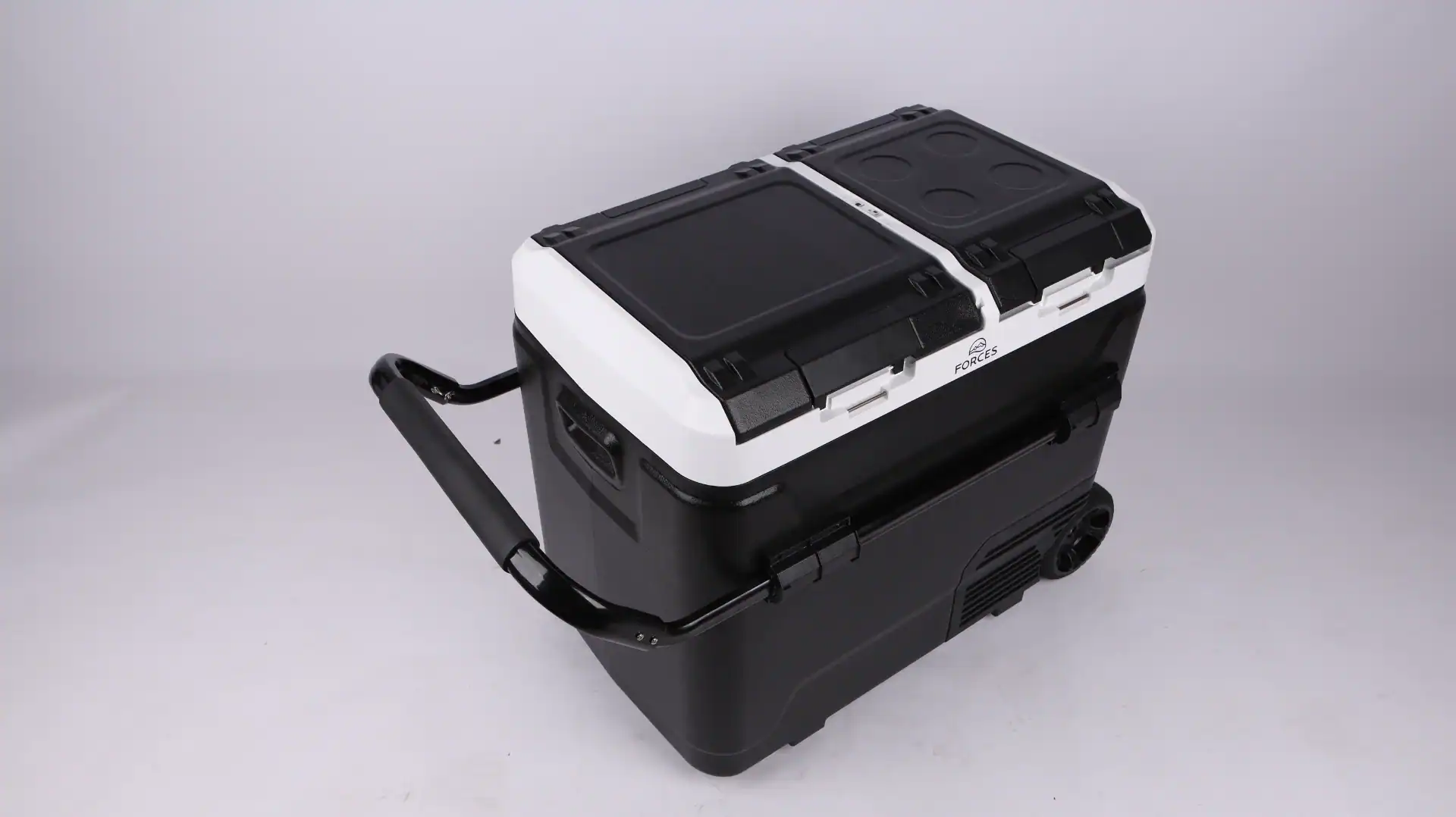
A black and white portable car fridge with a handle and wheels, ideal for travel and outdoor use.
Packaging MOQ often exceeds fridge MOQ — plan around it.
Standard 12V compressor car fridges carry a 300–500 unit MOQ. Thermoelectric coolers start at 100–200 units. Those numbers come from the assembly line — the cabinet tooling, compressor batch sizes, and foaming molds. But the packaging supplier operates on a different scale.
The Packaging MOQ Trap
A custom color box with your logo and retail graphics requires a separate production run at the box printer. Most packaging suppliers in Ningbo set a minimum of 1,000 boxes per design. That means you can order 300 fridges from KelyLands’ Ningbo-based fridge line but still be forced to commit to 1,000 boxes — paying for 700 you cannot use or eating the cost of inventory sitting in your warehouse.
This mismatch is where first-time importers lose margin before the container leaves the factory. The fridge line runs efficiently at 300 units. The box line does not.
Three Ways to Break the Packaging MOQ
Use standard master cartons for pilot runs. Skip custom retail packaging on the first order. Ship in plain brown export cartons with a stickered label. Test sell-through rates before committing to branded boxes.
Order mixed SKUs under one box design. If you need both 15L and 25L models, use the same color box for both with a model sticker variation. The packaging supplier counts by design, not by SKU.
Negotiate split delivery with your fridge supplier. Some factories like KelyLands can coordinate with their packaging partner to release boxes in batches against a single PO, effectively lowering your upfront commitment without changing the contract MOQ.
Low-MOQ Car Fridge Risks
Low-MOQ car fridge orders carry risks that don’t show up on the quote sheet.
A volume importer placed a 400-unit trial order for compressor fridges in May. The supplier confirmed a 30-day lead time. The container shipped on day 55 — too late for the July retail launch. The cause wasn’t factory capacity or raw material shortages. It was compressor allocation.
Compressor Allocation Delays
Compressor vendors allocate motors in advance to annual contracts. A supplier promising 30 days can still miss shipment if its compressor vendor prioritizes larger clients who signed yearly volume commitments. Small orders get bumped. This isn’t a production issue — it’s a supply chain pecking order problem that no Alibaba quote will disclose.
The fix is straightforward: demand written compressor allocation confirmation from the supplier before paying the deposit. That document should name the compressor brand, model, quantity reserved for your order, and the vendor’s delivery date to the assembly line. If the supplier hesitates, you know where your order sits on their priority list.
Gold-Sample vs Mass-Production Gaps
Pre-production samples often arrive flawless. That’s because suppliers use premium components — genuine Danfoss compressors, thicker gauge wiring, higher-grade control boards — to win the order. Once mass production starts, those components can be swapped for lower-cost alternatives without changing the outward appearance.
The gap shows up three months later when units start failing under load or cooling performance drops below spec. Standard AQL inspection catches surface defects but won’t detect a swapped compressor or thinner internal wiring unless you tear down random units from different production batches.
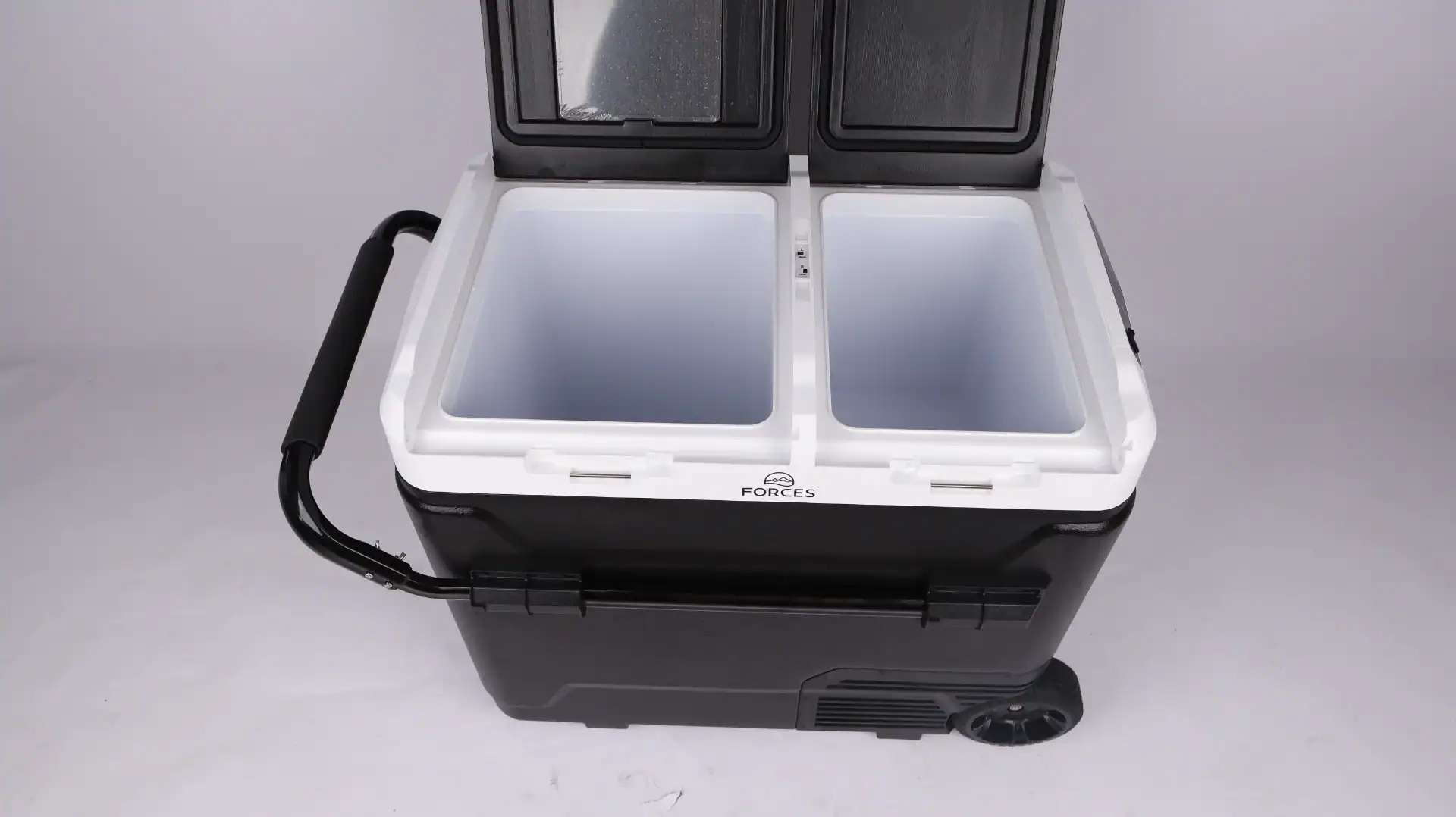
Dual-compartment portable car fridge with ergonomic handle and wheels, designed for easy transport and efficient cooling.
Car Fridge Lead Time Cost Breakdown
The compressor allocation confirmation — not the factory promise — controls your real lead time.
Most importers treat lead time as a single number on a quote. It is not. A car fridge order passes through four distinct stages, and each one can add days or weeks if not managed. Here is the breakdown for a standard 12V compressor fridge from Ningbo.
Production Timeline by Process
Compressor procurement eats the first 10–15 days. This is where the real risk lives. The compressor vendor allocates motors based on annual contracts, not individual orders. If your supplier does not have a confirmed allocation slot, those 10 days stretch to 25 while they wait for the next batch. Cabinet foaming and assembly take another 8–12 days. Quality testing — including 4-hour run-in tests and voltage tolerance checks — adds 3–5 days. Packaging and labeling consume the final 2–3 days. Total: 25–35 days for a standard unit.
Add 10–15 days if you order custom retail packaging with color boxes, foam inserts, or multi-language labels. The box maker runs its own MOQ and production queue, independent of the fridge line.
Freight, Documents & Hidden Delays
Sea freight from Ningbo to Los Angeles or Rotterdam runs 20–30 days depending on the sailing schedule and transshipment stops. Pre-shipment inspection takes another 3–7 days — book it early or it stalls your booking window. Shipping documents (bill of lading, certificate of origin, packing list) need 2–5 days after loading.
Two hidden delays kill timelines consistently: Chinese New Year shuts down factories and forwarders for 2–4 weeks regardless of what your contract says; incorrect HS codes trigger customs holds that cost $200–500 per day in demurrage plus reclassification fees.
Landed Cost Math: FOB vs CIF
Compressor vs Thermoelectric MOQ Tradeoffs
Thermoelectric coolers sell fast in summer.
The choice between compressor and thermoelectric car fridges is not just about cooling performance. It directly determines your MOQ, per-unit cost, return rate, and inventory velocity. Get the mix wrong, and you either tie up cash in slow-moving stock or miss the summer peak entirely.Performance & Price per UnitCompressor fridges maintain set temperature even when ambient heat hits 43°C. That matters for overlanding markets in Australia, the Middle East, and the US Southwest. Thermoelectric coolers drop to about 20°C below ambient — fine for a picnic cooler, useless for keeping meat safe on a two-day trip. The performance gap drives a return-rate gap: thermoelectric units returned for insufficient cooling can hit 8–12% in hot-climate regions, versus under 2% for compressor models.Inventory Velocity & SeasonalityThermoelectric coolers move fast during a narrow window — typically May through August in northern hemisphere markets. A distributor who misses that window sits on inventory until next year or discounts into negative margin. Compressor fridges sell year-round: camping season, road-trip holidays, tailgating, and increasingly as auxiliary fridge space for families who want frozen food on long drives.
Car Fridge MOQ & Lead Times: A Guide for Volume Importers
Car fridge MOQ lead times matter when mass production drops cooling performance by 10 degrees compared to the approved sample.
Book 60 days ahead of peak season or risk a 25-day lead time extension.
You have the MOQ and lead time benchmarks. Now you need to lock production without tying up cash in inventory that sits for months. The trick is booking capacity early and using contract clauses that protect your margin.Booking Windows & Contract ClausesStandard practice for Ningbo-based car fridge lines is a 30% T/T deposit with the balance paid against the bill of lading. That keeps your cash exposure manageable. For a first order, specify a 60-day advance booking window before your target ship date. That gives the factory time to secure compressor allocation from third-party vendors — the real bottleneck that turns a 30-day promise into a 55-day delay.Include two clauses most importers skip. First, a penalty for late delivery beyond the agreed lead time, typically 0.5–1% of the order value per week capped at 5%. Second, a 2% spare-parts allocation baked into the contract price. Those parts cover the defect threshold you should set below 2%. Without them, you eat replacement costs on warranty claims.Container Optimization by Capacity MixA single-SKU container wastes space and inflates per-unit freight. A 40HQ holds roughly 250 units of a single large model like a 40L fridge. Mix in smaller units — say, a core order of 15L, 25L, and 40L fridges — and that same container carries up to 400 units.
15L carton dimensions: Roughly 420 x 350 x 400 mm; stackable up to 3 high in distribution center racking.
25L carton dimensions: Roughly 500 x 380 x 450 mm; similar stacking strength with reinforced corners.
40L carton dimensions: Roughly 620 x 420 x 520 mm; requires heavier-duty outer carton to avoid collapse under load.
Confirm carton stacking strength with your supplier before loading. A collapse in transit means damaged units and denied insurance claims.Vendor Audit Checklist Before DepositBefore wiring that deposit, run through this checklist with every shortlisted supplier. It catches hidden risks that don’t show up on Alibaba quotes.
Compressor brand confirmation: Get it in writing: which brand (Aspen, Secop, or equivalent) and model number will be used in mass production? Cross-check against sample specifications.
QC inspection standard: Ask for their AQL level (Acceptable Quality Limit). Industry standard is AQL 2.5 for major defects; reject any supplier who cannot state theirs.
Factory audit report: Request an audit report from within the last 12 months — either self-conducted or by a third party like SGS or Bureau Veritas.
Third-party pre-shipment inspection: For first orders only: insist on an independent inspector checking random units before container loading. Budget $300–$500 per inspection.
Written warranty policy: Must state coverage period (typically 12–24 months), what is excluded (cosmetic damage), and defect threshold below 2%. Include replacement terms for defective units.
ConclusionThe gap between a quoted MOQ and a reliable shipment isn’t measured in units. It’s measured in compressor allocation confirmations, packaging minimums, and seasonal production slots. A supplier that can document its third-party compressor supply chain and offers flexible packaging options is one you can plan inventory around.
Demand written compressor allocation confirmation before deposit.
Use standard master cartons to break the packaging MOQ trap.
Book production slots at least 60 days before seasonal peaks.
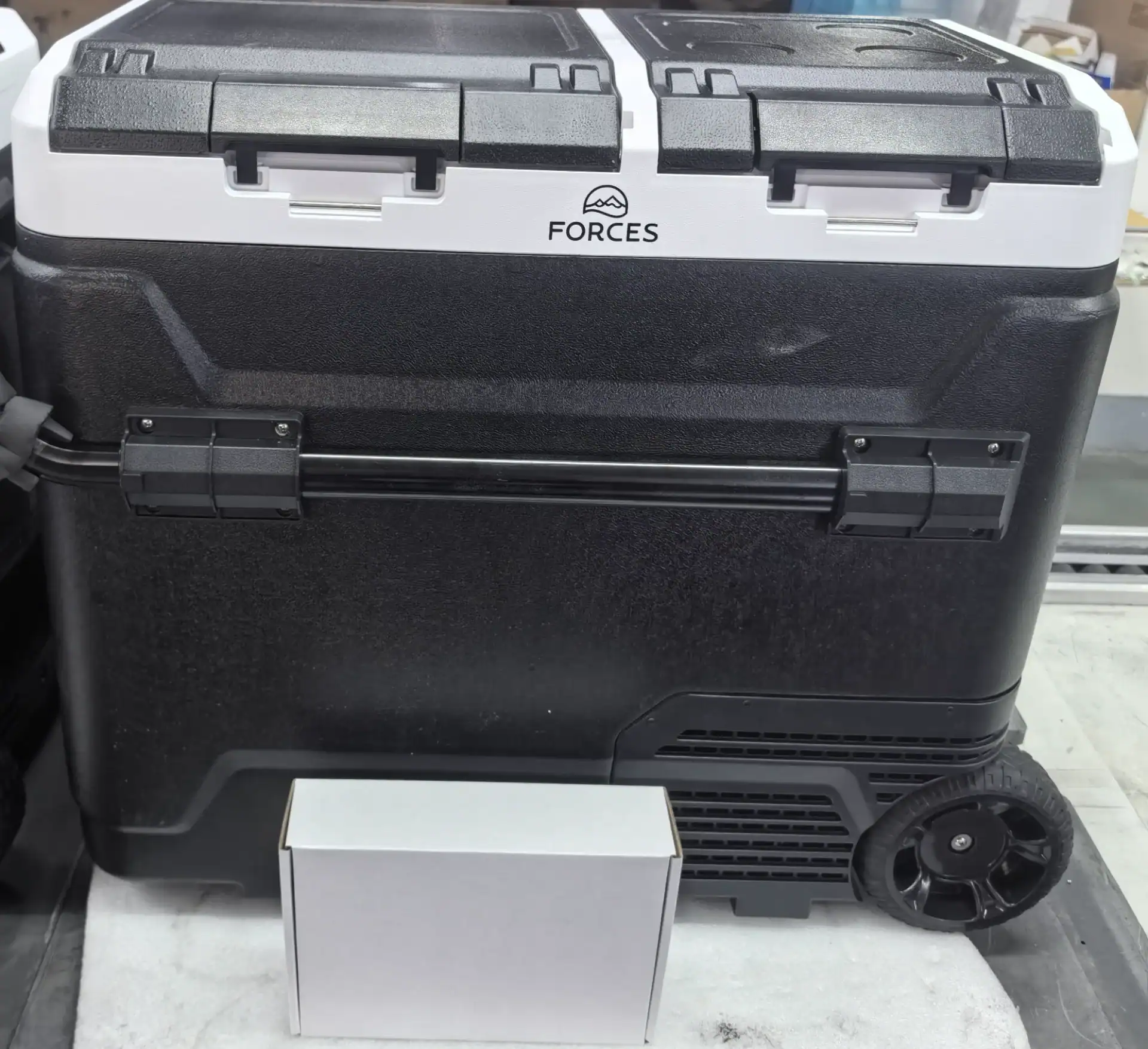
A rugged portable car fridge with wheels and durable design, perfect for outdoor and travel use.
Contract for a defect rate below 2% with spare parts allocation.
Before you finalize your shortlist, review the product specifications from a Ningbo-based manufacturer with over a decade of experience in car accessories and a track record of managing global supply chains across more than fifty countries. Compare their compressor sourcing strategy and production capacity against the benchmarks in this guide to see how they stack up for your next RFQ.Frequently Asked Questions
Cost Component
Lead Time Impact
Cost Impact on MOQ
Production (25–35 days)
Compressor allocation is the bottleneck; written confirmation required
Under 500 units: +15–30% per-unit premium
Custom Packaging Setup
+10–15 days for new color box tooling
Packaging MOQ can force 1,000 units; use master cartons to bypass
Pre-Shipment Inspection
+3–7 days; schedule before production ends
Included in FOB price; no direct per-unit cost change
Q: What is a typical car fridge MOQ for importers? A: Standard 12V compressor fridge MOQ often starts at 300–500 units; thermoelectric coolers can start at 100–?
The exact answer depends on the product specification, quantity, and order setup. The safest approach is to confirm the commercial terms only after the final requirement sheet is locked. Confirm MOQ after the final spec and customization scope are fixed.
Q: How long does it take to produce and ship car fridges from China? A: Production takes 20–35 days for standard units, plus 15–25 days sea freight to EU/US, 3–?
The exact answer depends on the product specification, quantity, and order setup. The safest approach is to confirm the commercial terms only after the final requirement sheet is locked. Lead time should be confirmed after quantity, finish, and shipping method are locked.
Hi, I’m Hanke Chen, the Head of KelyLands Sales Team. With over a decade of experience as a sales engineer, I bring in-depth expertise in the design, production, and sales of car accessories.
Please leave your information here, our team will get back to you soon..
WhatsApp us
We use cookies to ensure that we give you the best experience on our website. If you continue to use this site we will assume that you are happy with it.
 跳转到主要内容 跳转到页脚


 English
  Español
  Français
  Deutsch
  Português do Brasil
  Русский
  한국어
한국어  日本語
日本語  العربية