 跳转到主要内容 跳转到页脚
Choosing between digital and analog air pumps boils down to what matters most to you: precision or simplicity. Digital pumps deliver accuracy within ±1-2%, automatic shut-off features, and smart controls that make them perfect for professional use and demanding applications. Analog pumps counter with bulletproof reliability, lower costs, and mechanical toughness that works anywhere without batteries or electronics. This comprehensive guide breaks down performance, costs, durability, and real-world applications to help you pick the right portable tire inflator for your specific needs.
Understanding Air Pump Technologies
Digital and analog air pumps don’t just look different – they measure pressure in completely different ways, which affects everything from accuracy to reliability.
The biggest difference between digital air pumps and analog models lies in how they actually measure air pressure. Digital tire pressure gauges use electronic sensors that convert mechanical pressure into electrical signals, while analog tire pressure gauges rely on purely mechanical components that directly translate pressure changes into visual displays.
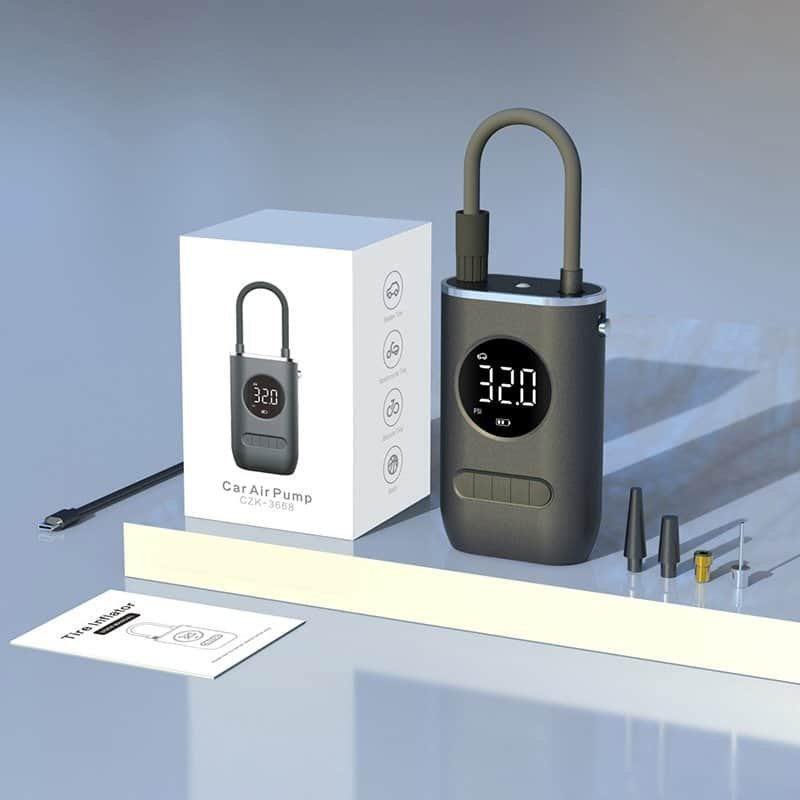
Digital car air pumps pack sophisticated technology under the hood. They use piezoresistive or capacitive sensors controlled by microprocessors, displaying readings on LCD screens with precision typically ranging from 0.1 to 1 PSI increments. This electronic architecture enables advanced features like programmable pressure targets, automatic shut-off functionality, and multiple unit conversions between PSI, BAR, and kPa.
Analog tire pressure gauges take a much simpler approach. They employ mechanical pressure measurement systems, most commonly Bourdon tubes or diaphragm mechanisms. When air pressure increases, these mechanical components physically move, translating pressure changes into needle movements across calibrated scales. This mechanical approach provides direct pressure indication without electronic interpretation, immediate response to pressure changes, and zero dependency on power sources for pressure readings.
Join 300+ global partners who trust KelyLands for top-tier car accessories. Review our portable air pumps in our free catalogue
Request now
Digital Air Pumps: Precision and Innovation
Digital air pumps shine when you need pinpoint accuracy and smart features – they’re like having a precision instrument that thinks for itself.
Digital air pumps typically offer accuracy within ±1% of reading, significantly outperforming most analog alternatives. This precision stems from solid-state pressure sensors that eliminate mechanical wear-related accuracy drift, temperature compensation algorithms that maintain accuracy across varying conditions, and digital signal processing that reduces noise while providing stable readings.
The user interface advantages are immediately obvious. Large, backlit displays improve readability in all lighting conditions, multiple unit displays eliminate conversion errors, and clear numerical values reduce interpretation mistakes. Many professional-grade portable tire inflators achieve accuracy within ±1-2 PSI across their entire range.
Advanced functionality sets digital pumps apart from their analog counterparts. Programmable settings allow users to set target pressures and rely on automatic shut-off to prevent over-inflation. Higher-end models offer Bluetooth connectivity, smartphone apps, and pressure history logging. Multi-application versatility includes preset modes for different applications like bicycle tires, car tires, and sports equipment.
Digital pumps face real limitations including power dependency for pressure display and advanced features. Battery powered inflators struggle in extreme temperatures and require regular charging or battery replacement. Electronic components introduce additional failure modes, including sensor drift, display malfunctions, and software glitches. The technology typically increases initial purchase price and may involve ongoing costs for battery replacement or software updates. Understanding the advantages and disadvantages of digital pressure gauges helps in making informed purchasing decisions.

Analog Air Pumps: Time-Tested Reliability
Analog air pumps are the workhorses that keep going when everything else fails – they’re built tough, cost less, and work anywhere without fuss.
Mechanical reliability represents the primary advantage of analog air pumps. Bourdon tube and diaphragm mechanisms withstand shock, vibration, and temperature extremes that challenge electronic alternatives. These systems contain no electronic components vulnerable to electromagnetic interference, and mechanical failures often provide clear visual indicators.
Environmental resilience allows analog pumps to function reliably in extreme temperatures where battery performance degrades, high-moisture environments where electronics may fail, and dusty or dirty conditions that affect sensitive sensors. Many analog pumps provide decades of service in harsh industrial environments.
Cost-effectiveness makes analog pumps attractive for budget-conscious buyers. Quality analog air pumps typically cost 30-50% less than equivalent digital models. They require no battery replacement, software updates, or compatibility concerns, and repair costs remain lower due to simpler components. Many analog pumps offer exceptional cost-per-use ratios through decades of reliable service.
Performance limitations include reading accuracy subject to parallax errors and interpretation variations between users. Accuracy typically ranges from ±2-5% depending on gauge quality and size. Mechanical components may experience calibration drift over time, particularly with heavy use or exposure to extreme conditions. Analog pumps cannot offer advanced features like automatic shut-off, preset pressures, or data logging.

Performance Comparison Analysis
Real-world testing shows digital pumps consistently beat analog models in accuracy, but analog pumps fight back with superior toughness and faster startup times.
Accurate tire pressure measurement tools testing shows digital pumps consistently outperform analog alternatives across pressure ranges. For low-pressure applications (10-30 PSI), digital pumps achieve ±0.5-1 PSI accuracy while analog pumps provide ±1-2 PSI accuracy. Medium-pressure applications (30-60 PSI) show digital pumps at ±1-2 PSI accuracy versus ±2-3 PSI for analog pumps. High-pressure applications (60+ PSI) demonstrate digital pumps achieving ±1-3 PSI accuracy compared to ±3-5 PSI for analog pumps.
Speed and efficiency comparisons reveal different strengths. Analog pumps require 5-10 seconds for immediate readiness, while digital pumps need 15-30 seconds including power-up and setting selection. Pump motor performance, not gauge type, primarily determines inflation speed. Digital pumps’ automatic shut-off can prevent over-inflation and reduce total task time in precision applications.
Durability testing shows analog pumps generally demonstrate superior resistance to physical abuse, with mechanical gauges surviving drops and impacts that damage digital displays. Temperature cycling, humidity, and chemical exposure affect each type differently. Digital pumps require periodic calibration, battery maintenance, and software updates, while analog pumps need only periodic calibration and occasional mechanical adjustment.
Application-Specific Recommendations
Different jobs call for different tools – professional mechanics swear by digital precision, while weekend warriors often prefer analog simplicity and reliability.
Professional automotive service benefits from digital pumps requiring precise tire pressure specification compliance, documentation for quality control, integration with digital service records, and consistent results across multiple technicians. Personal vehicle maintenance depends on individual priorities, with digital pumps serving precision-focused users, multiple vehicle types, and smartphone app integration, while analog pumps suit budget-conscious buyers and occasional use.
Cycling applications vary by discipline. Road cycling with high-pressure tires (80-120 PSI) benefits from digital precision for performance optimization through exact pressure tuning, tubeless tire setup requiring specific pressure ranges, and integration with cycling computer ecosystems. Mountain biking and gravel cycling with lower pressures (20-50 PSI) favor digital precision for trail-specific pressure adjustments and tubeless tire optimization. The debate between analog vs digital MTB pressure gauges often comes down to precision needs versus durability requirements. Casual and commuter cycling can rely on analog pumps for lower cost, simple operation, and durability with infrequent use.
Industrial and commercial applications show clear preferences. High-volume operations benefit from digital technology for consistent pressure standards across large tire volumes, reduced training requirements, and quality documentation. Emergency and field service favor analog reliability for independence from power sources, resistance to environmental extremes, and simplified repair in field conditions.
Cost Analysis and Value Proposition
Digital pumps cost more upfront and keep costing money with batteries and maintenance, while analog pumps are cheap to buy and virtually free to own long-term.
Initial purchase price varies significantly by market segment. Entry-level digital options under $50 offer limited features, basic accuracy, and shorter lifespan, while analog options provide good build quality, reliable performance, and proven durability. Mid-range digital pumps ($50-150) deliver good accuracy, useful features, and acceptable durability, compared to analog options offering professional-grade accuracy and excellent durability. Professional-grade units above $150 show digital options with excellent accuracy and advanced features competing against analog options with laboratory-grade accuracy and exceptional durability.
Operating costs favor analog pumps significantly. Digital pumps incur battery replacement costs of $10-30 annually for frequent users, calibration services costing $25-50 every 2-3 years, and potential software update requirements. Analog pumps avoid these ongoing expenses entirely.
Replacement frequency and repair costs differ substantially. Digital pumps typically last 5-8 years with regular use and cost $30-100 to repair, often approaching replacement cost. Analog pumps typically provide 10-20 years of service and cost $15-50 to repair, usually making repairs economical. For precision-critical applications, digital pumps justify higher costs through reduced waste from incorrect pressures and time savings from automatic features. For cost-sensitive applications, analog pumps provide better value through lower initial investment, minimal ongoing costs, and longer service life.
Expert Buying Guide
Smart buyers match their pump choice to their actual needs – don’t pay for precision you won’t use, but don’t skimp on accuracy when it matters.
Define your requirements by determining accuracy needs, usage frequency, environmental conditions, and budget constraints. Evaluate whether you prioritize precision over simplicity, features over reliability, integration over independence, and performance over cost. Consider future needs including expanding applications, integration with evolving technology systems, and maintenance infrastructure availability.
Choose digital when accuracy requirements exceed ±2 PSI, multiple pressure settings are frequently used, integration with digital systems provides value, user training minimization is important, or documentation and quality control are required. Digital pumps excel in professional environments and precision-critical applications where their advanced features justify higher costs.
Choose analog when budget constraints prioritize initial cost savings, environmental conditions challenge electronic reliability, simplicity and mechanical reliability are paramount, long-term cost predictability is important, or electromagnetic immunity is required. Analog pumps provide superior value for casual users and harsh environment applications.
Quality indicators for digital pumps include accuracy specifications from reputable testing, professional certifications and standards compliance, robust warranty coverage, positive long-term reliability reviews, and strong brand reputation in precision instrumentation. For analog pumps, look for proven gauge mechanism reputation, quality construction materials, accuracy certifications, professional endorsements, and realistic service life expectations with comprehensive warranty coverage. When evaluating options, consider consulting comprehensive reviews like the bike pumps for detailed performance comparisons.
Reliable Air Pumps for Every Inflation Need
Choose KelyLands air pumps for compact, multifunctional inflation solutions that support cars, bikes, motorcycles, sports balls, and more. With smart digital controls, high-pressure performance, and durable designs, these pumps fit roadside emergencies, daily maintenance, and outdoor adventures. Customize your brand with OEM/ODM options and rely on trusted quality and global support.
FAQ Section
What is the typical accuracy difference between digital and analog air pumps?
Digital air pumps typically achieve ±1-2% accuracy, while analog pumps generally provide ±2-5% accuracy. High-quality analog gauges can match digital accuracy, and low-quality digital pumps may not exceed analog performance. The key difference lies in consistency and ease of reading precise measurements without parallax error. For detailed comparisons, consider reviewing analog vs digital tire pressure gauges to understand which type best suits your needs.
Do digital air pumps require more maintenance than analog pumps?
Yes, digital air pumps require more maintenance due to battery replacement, software updates, and electronic component care. Analog pumps primarily need periodic calibration and mechanical cleaning. Digital pumps may require less frequent professional calibration due to their electronic stability, but overall maintenance requirements are higher.
How long do batteries last in digital air pumps?
Battery life varies significantly based on usage frequency, battery type, and environmental conditions. Alkaline batteries typically last 6-12 months with moderate use, lithium batteries last 12-24 months, and rechargeable batteries need replacement after 2-5 years. Cold temperatures can reduce battery life by 20-50%.
Which type is better for bicycle tire pressure?
For road cycling requiring precise high pressures (80-120 PSI), digital pumps provide better accuracy and automatic shut-off convenience. For mountain biking and casual cycling, analog pumps offer adequate accuracy with greater simplicity and reliability. Many cycling enthusiasts prefer digital for home use and analog for portable applications. When considering bicycle pumps, it’s important to explore whether you need features like wireless tire pump capabilities for enhanced convenience.
Are analog pumps better for automotive use?
Professional automotive applications increasingly favor digital pumps for consistency and documentation capabilities. Personal automotive use can be well-served by either type, with analog pumps offering cost advantages and digital pumps providing precision and convenience features. The choice depends on your specific accuracy requirements and budget.
Which type works better in extreme temperatures?
Analog pumps generally perform more reliably in extreme temperatures since mechanical components are less affected by temperature variations. Digital pumps may experience battery performance issues and sensor drift in very hot or cold conditions, though quality units include temperature compensation features.
Is the higher cost of digital pumps justified?
Cost justification depends on your specific needs. For precision-critical applications and professional use requiring consistency, the higher cost is usually justified. For occasional personal use and budget-conscious buyers, analog pumps provide better value. Consider total cost of ownership, not just initial price, when making your decision.

 English
  Español
  Français
  Deutsch
  Português do Brasil
  Русский
  한국어
한국어  日本語
日本語  العربية