 跳转到主要内容 跳转到页脚

Achieving a micro-mobility fit electric scooter tire pump setup is the primary defense against the high return rates caused by burst 8.5-inch tubes. Standard high-flow compressors overwhelm small-diameter tires, causing immediate bead failure and increasing maintenance overhead for bike shops.
This technical analysis benchmarks hardware featuring pure copper motors and smart auto-stop sensors to maintain ±1.5 PSI accuracy. We prioritize 150 PSI rated units with flexible hoses for recessed valve access to help distributors secure reliable, high-torque inflation solutions for their clients.
The 8.5″ Tire Struggle: Why do gas station pumps fail on scooters?
Commercial compressors dump air too quickly for small 8.5-inch tubes, risking instant blowouts. Portable digital inflators provide the precise control and auto-stop sensors necessary for micro-mobility safety.
The Dangers of Uncontrolled Airflow in Small Volumes
Commercial compressors deliver air at a high flow rate designed for 30-liter car tires. This volume easily overwhelms the tiny air capacity of 8.5-inch scooter tubes. When you trigger a gas station pump, the massive surge of air is too violent for small-diameter tires to absorb, often causing the tube to stretch or burst before the gauge even registers a change.
Most gas station equipment relies on analog gauges or high-pressure triggers that lack the sensitivity needed for the 30-55 PSI range. These systems usually cannot stop at the exact pressure required for electric scooters. This technical mismatch increases the risk of bead failure or the tube popping. For micro-mobility users, relying on equipment built for five-ton trucks is a recipe for frequent tire replacements.
Smart Auto-Stop Technology for Precise Pressure Control
KelyLands inflators address these mechanical risks by using Smart Auto-Stop technology. Users set the specific target PSI before starting the process. The system monitors pressure in real-time and cuts power to the pure copper motor immediately upon reaching the target. This automation removes human error and prevents over-inflation in small-volume systems.
The hardware uses an integrated sensor system that displays exact internal pressure on an LCD screen. We calibrate these units to maintain an accuracy of ±1.5 PSI, which is essential for maintaining the stability and safety of small electric scooter wheels. For wholesalers and distributors, providing an inflator with this level of precision ensures that end-users avoid the common blowouts associated with high-volume commercial pumps.

Valve Extenders: Why is a flexible screw-on hose mandatory?
Restricted scooter hubs require flexible hoses to bypass motors. Screw-on connectors are vital to prevent massive pressure drops in small tires during disconnection.
| Requirement | Standard Rigid Pump | KelyLands Flexible Extender |
|---|---|---|
| Wheel Clearance | Blocked by motors/discs | 360-degree reach |
| Air Retention | High loss on pull-off | Airtight threaded seal |
| Valve Stem Stress | Lateral pressure (tears) | Zero-tension connection |
Navigating Clearance Constraints in Micro-Mobility Hubs
Designers of 8.5-inch and 10-inch e-scooter wheels prioritize compact power over maintenance access. Most hubs house large motors or brake discs that effectively wall off the valve stem, leaving almost no room for a human finger, let alone a standard air chuck.
- Internal Obstructions: Hub motors and disc brakes on e-scooters leave minimal finger space around the valve stem.
- Access Angles: Rigid gas station air chucks require a straight-on approach that most scooter rims physically prevent.
- Bending Capability: Flexible extenders allow 360-degree bending to bridge the gap between the recessed valve and the pump nozzle.
- Stem Protection: Using a rigid connection puts lateral stress on the rubber valve stem, leading to premature tears and slow leaks.
Maintaining 150 PSI with Threaded High-Pressure Hoses
High-pressure maintenance in small-volume tires demands precision. When the total air volume is low, even a split-second hiss during disconnection can ruin the PSI accuracy. Screw-on mechanisms solve this by maintaining a mechanical lock until the seal is completely clear.
- High-Load Stability: KelyLands inflators use high-pressure hoses rated for 150 PSI to ensure stability during high-load inflation.
- Mechanical Seals: Screw-on Schrader connectors create a seal that remains airtight until the thread is fully released.
- Lossless Disconnect: This is vital for 8.5-inch tires; their low volume means a one-second hiss can drop pressure by 5-10 PSI.
- Precision Delivery: Threaded connections integrate with our Pure Copper Motor to deliver precise airflow without the risk of the nozzle popping off under pressure.
Premium OEM Car Air Pumps for Wholesale
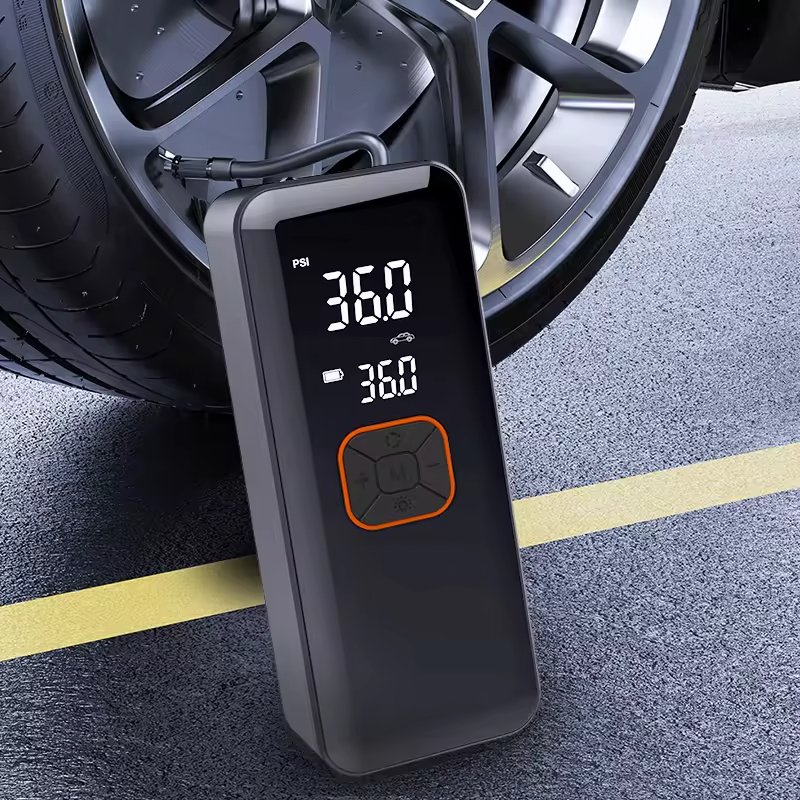
High Pressure/Low Vol: Reaching 50 PSI in a tiny tube.
Small scooter tires lose 2.5-5 PSI instantly during disconnect. Reliable inflation requires high-pressure overhead and digital auto-stop to compensate for this volume-sensitive air loss.
Standard car tires have a massive air reservoir that buffers minor leaks. Electric scooter tubes do not. Because the internal volume is so small, even the tiny “hiss” of air escaping when you unscrew a hose represents a significant percentage of the total pressure. Professionals in the micro-mobility space know that hitting a precise 50 PSI target is a game of compensation and hardware capability.
Pressure sensitivity in small-volume pneumatic systems
The physics of small tubes means that losing just a few cubic centimeters of air during disconnect results in a rapid pressure drop. This makes manual pumps or gas station compressors—which lack precision—dangerous or ineffective for high-performance scooters.
- Pressure Drop: Expect an immediate loss of 2.5-5 PSI during the detachment of standard threaded hoses.
- Compensation Strategy: We recommend inflating 1-2 PSI above the manufacturer’s target to account for the air escaping during the unscrewing process.
- Operational Ranges: Entry-level models typically need 30-40 PSI, while high-performance dual-motor scooters often demand 55 PSI to prevent rim damage.
Pure copper motors and 150 PSI pressure overhead
To push air into a tire already sitting at 45 PSI, the pump motor must overcome significant backpressure. Budget pumps with aluminum motors often overheat or stall before reaching the target. KelyLands hardware uses a different internal architecture to ensure consistency for B2B distributors and fleet managers.
- Pure Copper Motor: This configuration provides the high-torque output required for stable airflow and superior heat resistance during high-pressure cycles.
- 150 PSI Capacity: Our inflators are rated for 150 PSI, meaning they operate well within their mechanical limits when targeting the 50 PSI range common in scooters.
- Smart Auto-Stop: Digital monitoring allows users to set exact targets. The system cuts power once reached, eliminating the risk of over-inflation or tube bursts.
- Real-Time Monitoring: The LCD screen serves as a digital gauge with ±1.5 PSI accuracy, essential for small-volume maintenance where every pound of pressure counts.
Using the right hardware turns a frustrating maintenance task into a predictable process. For wholesale buyers, providing an inflator with a pure copper motor and digital presets ensures end-users don’t damage their equipment through guesswork or inadequate pressure delivery.

Lossless Disconnect: Keeping the air in when unscrewing.
Scooter tires lose 3-5 PSI instantly during disconnection. Lossless technology seals the tire valve before the pump head separates, locking in the exact target pressure.
The Physics of Air Bleed in Low-Volume Tires
Small tires have almost no margin for error. While a car tire can tolerate a minor hiss during disconnection, an 8.5-inch scooter tire operates on a high pressure-to-volume ratio. This means even a fraction of a second of air escape significantly compromises tire safety and performance.
- Pressure-to-Volume Ratio: Minimal air loss in small diameters translates to massive PSI drops.
- Mechanical Delay: Standard threaded connectors keep the valve pin depressed while the threads are still disengaging.
- Accuracy Negation: Air escape during the unscrewing phase often wipes out the precision of the initial inflation.
Smart Pressure Monitoring and Precision Valve Seals
KelyLands hardware solves this mechanical flaw through specialized connector engineering. We focus on ensuring the valve shuts before the atmospheric seal breaks, which is vital for maintaining 2026 safety standards for micro-mobility devices.
- Reinforced Seals: Our hoses utilize specialized seals designed to snap shut the moment connector tension eases.
- Precision Monitoring: Internal sensors provide accuracy of ±1.5 PSI to account for minor atmospheric equilibrium.
- Smart Auto-Stop: The pump reaches the target threshold and stabilizes before the user begins the manual disconnect process.
By integrating these hardware-level solutions, we eliminate the need for users to “over-inflate and hope” to reach their actual target pressure.
Frequently Asked Questions
How do I pump air into a Xiaomi M365 or scooters with recessed valves?
You must use a valve extender to reach the embedded air valve, particularly on the front wheel. Attach the extender to the pump first, then screw it onto the valve. Because these tires have small volumes, add air in short bursts to avoid over-inflation or tube damage.
What is the best type of pump for 8.5-inch electric scooter tires?
Portable electric pumps are the most practical choice. They offer the necessary pressure range (up to 150 PSI) and digital gauges for accuracy. Manual pumps often lack the precision needed for small scooter tires, where even a 2-3 PSI difference affects ride quality.
Is 50-60 PSI the standard pressure for electric scooters?
Most electric scooters operate best between 40-50 PSI. Pushing tires to 60 PSI often exceeds the maximum rated pressure printed on the sidewall, which can lead to tire failure. Always follow the specific PSI range provided by the manufacturer or the tire casing.
How can I stop air from escaping when unscrewing the pump hose?
Air loss of 1-7 PSI is common with standard threaded hoses. You can prevent this by using a pump with a zero-loss chuck or a quick-release lever. If using a standard screw-on hose, inflate the tire 2 PSI above your target to account for the air lost during disconnection.
Does a portable pump include the necessary adapters for all scooters?
Most units come with a universal nozzle adapter set, including a ball needle and Presta valve adapter. While standard Schrader valves are the industry norm, some scooters with deeply recessed valves might require a specific flexible extender if one was not included with the vehicle.
Final Thoughts
Relying on cheap, high-volume pumps leads to burst tubes and damages your reputation as a professional dealer. KelyLands pure copper motors and smart auto-stop sensors provide the ±1.5 PSI accuracy essential for sensitive 8.5-inch scooter tires. Investing in specialized hardware eliminates customer blowouts and reduces the logistics costs of returns.
Verify our build quality and hub clearance by requesting a sample kit for your service department today. We offer full OEM customization and private labeling for established micro-mobility wholesalers. Contact our team to review our latest catalog and secure production slots for the upcoming season.

 English
  Español
  Français
  Deutsch
  Português do Brasil
  Русский
  한국어
한국어  日本語
日本語  العربية