 跳转到主要内容 跳转到页脚

Calculating the thermal shock physics of a glass travel kettle dictates whether a new appliance line passes strict safety compliance or faces catastrophic warranty liabilities. Engineers constantly battle material limitations when designing compact boiling devices for consumers. Relying on standard plastics or low-grade glass triggers chemical leaching complaints and sudden structural failures during rapid temperature shifts. These material weaknesses directly cause shattered units on hotel counters, potential user scald injuries, and immediate brand damage in the competitive retail market.
This technical brief serves as a standard operating procedure for specifying borosilicate material thresholds over standard polymers. We analyze the exact temperature differentials required to survive ice to boiling water transitions without fracturing. The following sections detail how high-grade glass completely eliminates residual chemical odors, examine seamless heating plate fusion methods to prevent silicone gasket leaks, and evaluate bare unit weight differences compared to stainless steel alternatives. Procurement teams and product developers apply these metrics to enforce tight manufacturing tolerances directly on the factory floor.
Why Does High Borosilicate Glass Eliminate the “Plastic Odor” Completely?
Borosilicate glass relies on a dense, non-porous microscopic structure and chemical inertia to physically block volatile compounds, guaranteeing zero odor retention even under continuous boiling cycles.
Non-Porous Surface Structure
The fundamental difference in microscopic structure between glass and plastic dictates how these materials handle odors. Plastics feature a porous microscopic composition that absorbs and traps microscopic odor molecules, particularly when exposed to heat. High borosilicate glass possesses a dense, smooth surface that physically prevents bacteria, stains, and residual smells from embedding into the material.
KelyLands equips premium 12V/24V car kettles, like the SM400 model, with high borosilicate glass. This engineering choice ensures long-haul drivers enjoy fresh water free from trapped odors. Upgrading to a completely non-porous material directly solves the “plastic taste” customer complaints that plague standard travel appliances, driving higher satisfaction for retail and fleet buyers.
Chemically Inert Material Properties
Standard plastic containers often degrade and release volatile compounds into the water during the boiling process, causing a noticeable chemical smell. Borosilicate glass stays chemically inert. It refuses to react with liquids or leach any compounds into the water, regardless of the boiling frequency or the water’s mineral content.
This chemical stability guarantees that B2B wholesale buyers receive a safe, compliant product. The material maintains high hygiene standards over years of continuous use. Fleet procurement managers rely on this stability to provide drivers with safe, medical-grade boiling capabilities for baby formula, specialty coffee, or daily hydration without the risk of ingesting degraded plastic compounds.
Long-Term Maintenance of Water Purity
Eliminating odor retention directly improves the long-term usability and cleanliness of the boiling appliance. Professional kitchens and food storage industries increasingly adopt borosilicate glass because it maintains product purity without long-term material degradation. Users easily wash away any residue from the glass surface, avoiding the permanent staining and smell retention common in standard plastic kettles.
By integrating this premium material, KelyLands ensures their car kettles easily meet strict LFGB and PRO65 certifications. This compliance provides an odor-free boiling experience for logistics fleets and RV outfitters. The transparent nature of the glass, combined with built-in blue LED visual indicators, allows users to visually verify water purity and cleanliness instantly.
Can Borosilicate Withstand the Thermal Shock of Ice to Boiling Water?
Engineered with boron trioxide, high borosilicate glass achieves a remarkably low thermal expansion coefficient of 3 × 10⁻⁶ K⁻¹, allowing it to absorb sudden 120°C temperature shifts without structural failure.
The Molecular Structure of Borosilicate Glass
Manufacturers add boron trioxide to silica to form the primary structure of borosilicate glass. This specific chemical composition creates a rigid matrix that minimizes expansion and contraction during rapid temperature shifts. The resulting material possesses a low coefficient of thermal expansion of approximately 3 × 10⁻⁶ K⁻¹.
This expansion rate sits at roughly one-third that of standard soda-lime glass. By restricting volumetric changes under thermal stress, borosilicate prevents the sudden fractures typical of conventional glass. The stable molecular bonds also deliver exceptional chemical durability, resisting acid and alkali degradation ten times better than standard alternatives.
Temperature Differentials and Thermal Limits
The transition from freezing ice water (0°C) to active boiling water (100°C) falls well within the normal operating parameters of this material. Engineers rate borosilicate for safe, sudden temperature shifts up to 120°C under everyday conditions, with an absolute maximum thermal shock resistance of 160°C (330°F).
| Material Type | Thermal Expansion Coefficient | Max Sudden Temp Shift |
|---|---|---|
| High Borosilicate Glass | ~3 × 10⁻⁶ K⁻¹ | 160°C (330°F) Limit |
| Standard Soda-Lime Glass | ~9 × 10⁻⁶ K⁻¹ | <50°C (High Shatter Risk) |
Beyond handling sudden shifts, the glass operates safely at sustained continuous temperatures up to 250°C. For brief intervals, the material withstands exposure up to 400°C without compromising its underlying structural integrity.
Application in 12V/24V Automotive Kettles
OEM manufacturers like KelyLands utilize High Borosilicate Glass in premium 12V and 24V car kettle models, specifically the SM400 series. This specific material choice protects the appliance from shattering when drivers pour cold water into a recently boiled, still-warm kettle during back-to-back use. The thermal stability of the borosilicate body pairs perfectly with the demanding 30-minute continuous boiling cycles required by standard 150W to 300W automotive kettles.
We integrate this robust glass alongside a proprietary Triple Safeguard system to maximize in-car safety for long-haul fleets. This hardware package includes:
- An auto-off switch triggered immediately upon reaching a rolling boil.
- Recoverable temperature controllers for consistent heat management.
- An irrecoverable thermal fuse for strict physical dry-boil prevention.
High-Safety OEM Car Kettles for Wholesale
Is the Heating Plate Fused Seamlessly to Prevent Silicone Gasket Leaks?
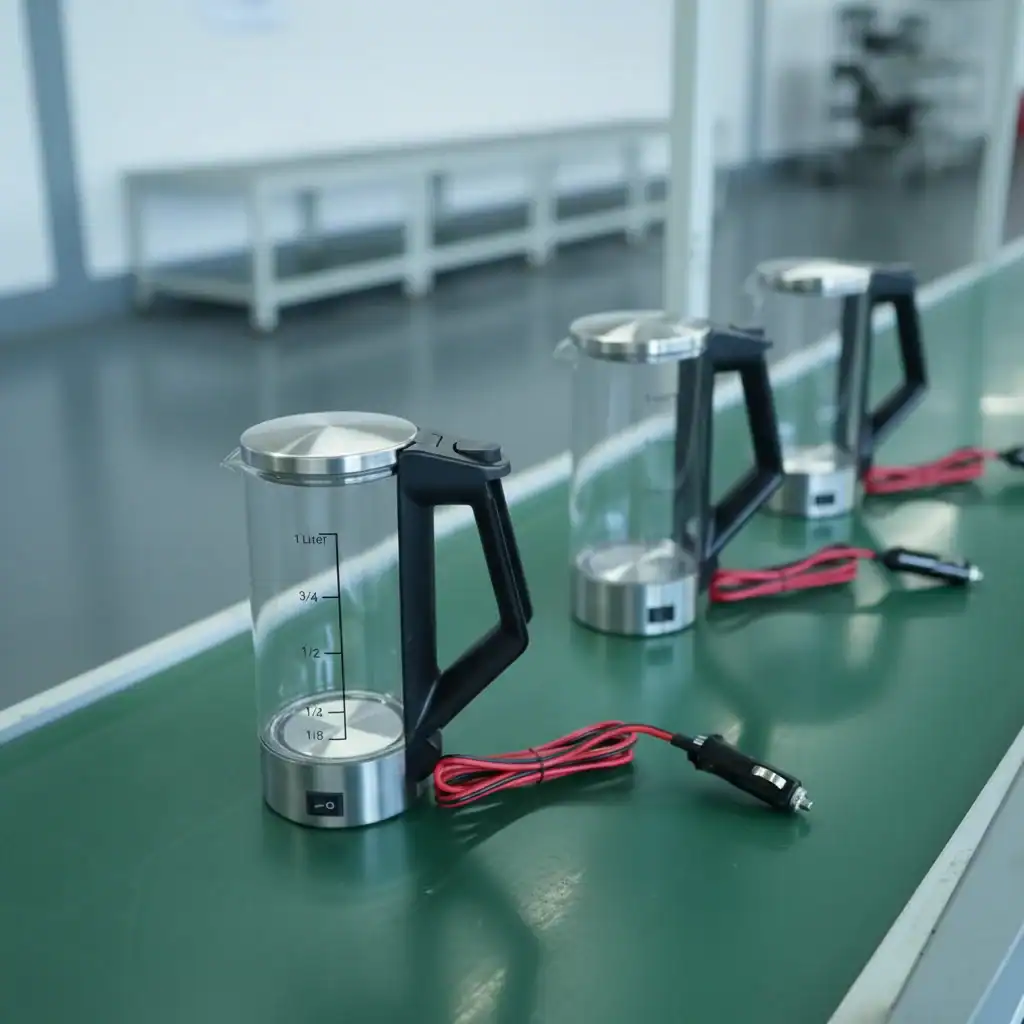
KelyLands eliminates leakage risks by employing high-temperature metallurgical brazing to fuse the heating plate directly to the base, entirely bypassing the failure points of traditional chemical adhesives.
Seamless Fusion Techniques in Appliance Assembly
Modern manufacturing methods integrate heating elements with the base structure to minimize gap expansion. Engineers use advanced thermal bonding—specifically metallurgical brazing—to attach heating plates directly to the appliance base. This process melts aluminum between the heating element and the base plate, creating a permanent bond that easily withstands the 1,200°C operating temperatures of the internal nichrome wires.
This integrated approach minimizes micro-gaps that typically form when different materials expand at varying rates. Eliminating mechanical fasteners and standard adhesives removes the physical stress points where water usually bypasses the primary seal.
| Assembly Method | Thermal Tolerance | Leakage Risk Level |
|---|---|---|
| Standard Chemical Adhesives | Degrades above 150°C | High (Micro-gaps form over time) |
| Mechanical Fasteners | Uneven expansion stress | Moderate (Vulnerable to vibration) |
| Metallurgical Brazing (KelyLands) | Withstands up to 1,200°C | Zero (Seamless molecular bond) |
Silicone Gasket Performance During Thermal Cycling
High-grade silicone maintains its structural integrity despite constant shifts from ambient to boiling temperatures. We utilize food-grade silicone rings designed to handle repeated temperature shifts without hardening, cracking, or off-gassing over extended operational periods.
- The gasket design accommodates the specific thermal expansion coefficient of the surrounding metal and borosilicate glass components.
- The fused base applies continuous compression, keeping the silicone ring locked tightly against the vessel wall.
- The engineered material absorbs structural tension during rapid 12V/24V heating cycles, preventing microscopic deformations.
KelyLands’ Quality Assurance for Water-Tight Seals
Rigorous testing protocols ensure every 12V/24V appliance maintains a secure seal under operational pressure. KelyLands subjects every glass kettle, including the premium SM400 model, to a strict triple-layer inspection process comprising IQC, PQC, and FQC.
- Factory technicians test 100% of the units for thermal shock resistance to confirm the brazed base seal holds during extreme temperature changes.
- Quality control teams verify the physical dry-boil prevention systems, ensuring the silicone gasket does not warp if the kettle operates without water.
- Inspectors run high-stress pressure simulations to validate the structural integrity and watertight nature of the brazed joints before packaging.
What Is the Weight Difference Between a Glass and Stainless Steel Unit?
Borosilicate glass kettles carry significantly more mass than stainless steel counterparts due to the structural thickness required to resist thermal shock, fundamentally altering in-cabin maneuverability for drivers.
Material Density and Wall Thickness Factors
High borosilicate glass demands thicker walls to maintain structural integrity and resist thermal shock during rapid heating cycles. This physical requirement inherently increases the base weight of the kettle before adding any water. Stainless steel units rely on much thinner material walls. The high tensile strength of the metal achieves identical or superior durability while keeping the overall unit significantly lighter.
| Material Composition | Wall Thickness Profile | Estimated Base Unit Weight (1000ML) |
|---|---|---|
| High Borosilicate Glass (SM400) | Thick (Thermal Shock Resistant) | ~1.08 KG (2.38 lbs) |
| Food-Grade Stainless Steel (SM408) | Thin (High Tensile Strength) | ~0.65 KG (1.43 lbs) |
Impact on Handling and In-Car Maneuverability
The physical mass directly affects usability for drivers navigating mobile environments. A heavy glass kettle demands higher grip strength, particularly when holding a full 1000ML of boiling water. This added weight complicates pouring control inside a moving commercial truck or an RV. Stainless steel alternatives offer superior maneuverability. Drivers easily lift, pour, and stow these lighter units inside tight vehicle cabins. Fleet managers evaluate the absolute material purity of glass against these practical handling demands during long-haul transit.
Weight Considerations for KelyLands 1000ML and 600ML Models
KelyLands engineers distinct solutions to address these handling preferences across the B2B market. The flagship 1000ML SM400 high borosilicate glass model carries more physical mass than the 1000ML stainless steel SM408. Commercial logistics fleets frequently specify the lighter stainless material to maximize driver ergonomics. Buyers targeting the zero-odor purity of glass often select our compact models to offset the weight of premium glass components. We categorize our primary offerings based on these exact mobility profiles:
- Heavy-Duty 1000ML (SM Series): Provides maximum liquid volume for long-haul routes, requiring operators to handle a heavier overall unit.
- Compact 600ML (CC Series): Offsets the structural weight of borosilicate glass, delivering a highly portable footprint for passenger cars and tight cabins.
Conclusion
Selecting high borosilicate glass over traditional plastics fundamentally upgrades product quality and resolves common customer complaints about chemical odors. A seamlessly fused heating plate and robust thermal shock resistance ensure reliable performance across changing travel environments. These manufacturing standards protect brand reputation by lowering return rates and ensuring long-term product durability.
Evaluate your current product lineup to see if a material upgrade aligns with your premium retail goals. Contact our team to request a testing sample of the SM400 glass series and review our complete B2B wholesale catalog.
Frequently Asked Questions
Can a glass travel kettle handle sudden temperature changes?
Yes, high-quality glass travel kettles are constructed from borosilicate glass, which has a very low coefficient of thermal expansion. This specialized material is engineered specifically to withstand thermal shock, allowing the kettle to safely handle sudden and extreme temperature changes—such as going from cold tap water to boiling temperatures—without the risk of cracking or shattering.
Does the glass travel kettle eliminate plastic smells?
While it does not “eliminate” existing odors from other materials, a glass travel kettle avoids the issue entirely. Because it is made of non-porous, chemically inert borosilicate glass, its smooth surface prevents odor molecules, bacteria, and stains from embedding. This ensures that your boiled water remains completely pure, fresh, and free of the residual plastic smells commonly associated with traditional plastic travel kettles.
What is the weight of a portable glass boiler for luggage?
A standard portable glass travel kettle typically weighs between 1.5 and 2.5 pounds (0.7 to 1.1 kilograms) when empty. Manufacturers design these units specifically for travel, utilizing lightweight yet durable borosilicate glass and compact, streamlined heating bases to minimize bulk and ensure they fit comfortably within standard airline luggage weight restrictions.
Is the bottom heating element glued or seamlessly fused?
In premium glass travel kettles, the bottom heating element (typically made of 304 or 316 food-grade stainless steel) is seamlessly fused or securely integrated using medical-grade silicone seals rather than traditional adhesives. This seamless construction prevents chemical leaching, ensures water never comes into contact with glue, and provides a durable, leak-proof seal that withstands repeated boiling cycles.

 English
  Español
  Français
  Deutsch
  Português do Brasil
  Русский
  한국어
한국어  日本語
日本語  العربية