 跳转到主要内容 跳转到页脚
Portable tire inflators are compact devices that use compressed air to maintain optimal tire pressure, serving as essential tools for vehicle safety, fuel efficiency, and preventing premature tire wear—yet the marketplace is plagued by misleading claims and falsified specifications that make expert guidance crucial for avoiding costly mistakes. These versatile devices, typically powered by 12V car outlets or rechargeable batteries, have evolved into sophisticated multi-functional tools with digital precision, automatic shut-off features, and integrated jump starter capabilities that can be the difference between safe arrival and dangerous roadside emergencies.
Introduction
Proper tire inflation represents a critical safety frontier that most drivers dangerously underestimate—underinflated tires create excessive rolling resistance that forces engines to work harder while dramatically increasing the risk of catastrophic blowouts that can cause serious accidents and injuries. Beyond immediate safety concerns, the financial stakes are equally compelling: properly inflated tires can improve fuel efficiency by up to 9% and significantly extend tread life by preventing the accelerated, uneven wear patterns that plague underinflated tires.
The marketplace, however, presents a minefield of misleading claims and outright scams that prey on uninformed consumers. Recent investigations have exposed how manufacturers routinely falsify battery capacity specifications, with some portable inflators claiming impossible power ratings while failing basic performance tests—yet these same products accumulate thousands of glowing reviews on major retail platforms. This deceptive landscape makes expert guidance not just helpful, but essential for avoiding costly mistakes and ensuring you invest in equipment that will actually perform when you need it most, whether stranded on a remote highway or simply maintaining optimal pressure in your driveway.
Join 300+ global partners who trust KelyLands for top-tier car accessories. Review our portable air pumps in our free catalogue
Request now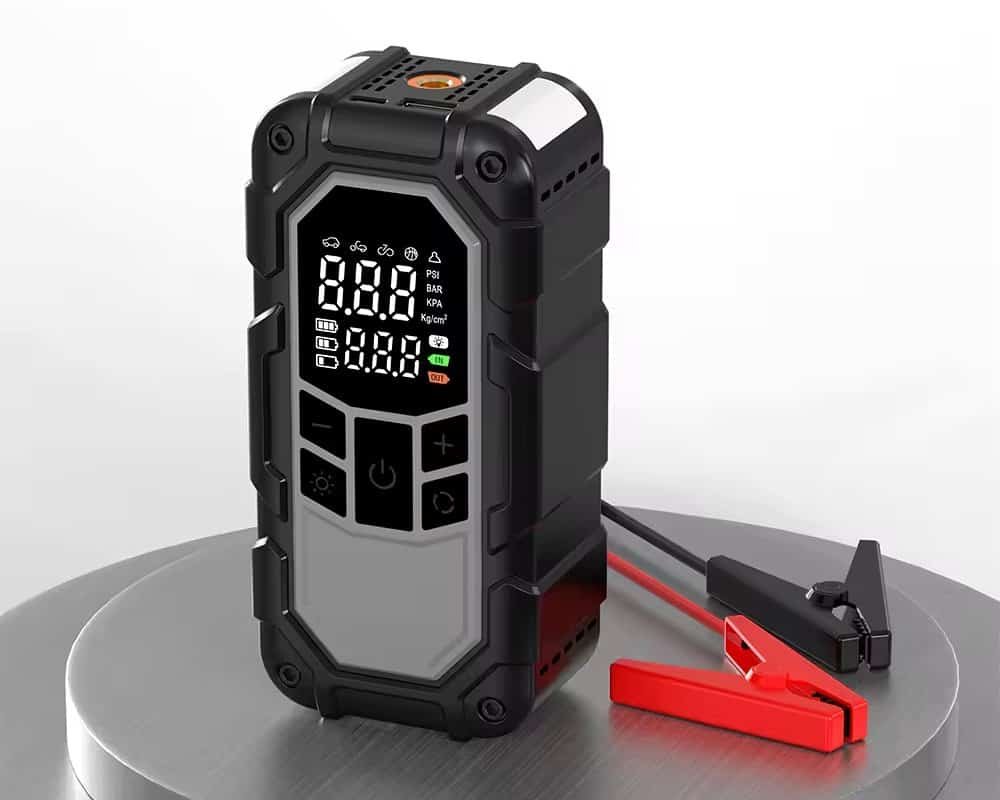
Understanding Tire Inflators — Foundations of Tire Safety and Performance
Why Tire Pressure Matters: The Science Behind Safety and Efficiency
Improper tire pressure creates serious safety and economic consequences. Underinflated tires generate excessive heat through sidewall flexing, breaking down internal components and leading to blowouts, while also distorting the contact patch and reducing steering response and traction. Overinflated tires become rigid and prone to impact damage, compromising braking performance and ride comfort.
Economically, underinflated tires increase rolling resistance, reducing fuel economy and shortening tire life by approximately 15,000 kilometers through accelerated wear. TPMS systems only warn of dangerously low pressure but cannot prevent the natural 1 PSI monthly pressure loss through diffusion. Temperature changes compound this issue—every 10-degree Fahrenheit shift causes a 1 PSI pressure change, explaining why TPMS lights often activate on cold mornings.
Types of Car Air Pumps: From Analog to Digital, Corded to Cordless
Modern tire inflators offer diverse options to meet varying user needs and preferences. The choice between different types depends on factors like power requirements, portability needs, and intended usage frequency.
| Inflator Type | Key Features | Power Source | Best For |
|---|---|---|---|
| Basic Analog | Mechanical dials, simple operation | 12V DC outlet | Budget-conscious users, basic inflation needs |
| Digital Units | Backlit LCD displays, preset pressure targets, automatic shut-off | 12V DC outlet | Precision inflation, ease of use |
| Portable Air Compressors | High-volume airflow, heavy-duty performance | 12V DC outlet | Larger tires, frequent use |
| Handheld Inflators | Compact size, lightweight, portable | Battery or 12V DC | Emergency use, convenience priority |
| Corded Models | Unlimited runtime, consistent power | Cigarette lighter connection | Extended use sessions, reliable power |
| Battery-Powered Units | Complete mobility, cordless operation | Rechargeable battery | Emergency situations, home use |
| Direct Battery Connection | Maximum power, rapid inflation capability | Heavy-duty clamps to car battery | Multiple tires, larger recreational equipment |
Innovations in High-End Pumps: Multifunction Features and Smart Tech
Premium inflators have evolved into comprehensive roadside assistance tools, integrating jump starter capabilities with lithium-ion power banks that can charge smartphones and tablets during emergencies. Advanced models feature dual-cylinder compressors that significantly reduce inflation times while generating less heat buildup, extending motor life and improving reliability during extended use sessions.
Smart technology integration includes programmable pressure presets for different tire types, automatic shut-off systems that prevent overinflation, and LED work lights with multiple brightness settings and emergency strobe functions. Some high-end units incorporate wireless tire pressure sensors that provide real-time readings without manual gauge placement, while others feature smartphone connectivity for monitoring inflation progress and storing vehicle-specific pressure settings.
Selecting the Perfect Tire Inflators — Matching Features to Your Needs
How to Assess Your Vehicle’s Tire Size & Inflation Requirements
Vehicle type and tire size directly dictate the inflator specifications you’ll need for effective performance. Sedans typically require 30-35 PSI and can be adequately served by compact inflators with 1-6 gallon tank capacities, while SUVs and light trucks operating at 35-45 PSI benefit from more robust units with higher CFM ratings for faster inflation times. Heavy-duty trucks and vehicles with oversized tires may require inflators capable of 120-150 PSI maximum pressure, particularly when running non-stock tire sizes that demand different pressure calculations than the door placard recommendations.
Duty cycle becomes critical when matching pump capacity to tire volume—small reciprocating compressors suitable for passenger cars can overheat and fail when tasked with repeatedly inflating large truck tires or multiple tires in succession. Understanding your vehicle’s specific requirements prevents the common mistake of purchasing an undersized inflator that struggles with your tire dimensions, leading to extended inflation times, motor burnout, and potential safety hazards during roadside emergencies.
Pressure Accuracy & Preset Features: Why Precision Matters
Digital pressure gauges offering ±1 PSI accuracy represent a significant advancement over analog systems, particularly for performance vehicles where minor pressure variations affect handling characteristics and tire wear patterns. Automatic shut-off systems eliminate the guesswork and potential for dangerous over-inflation, allowing users to set target pressures and walk away while the inflator completes the task safely.
Preset pressure features prove especially valuable for drivers managing multiple vehicles or tire types, storing common pressure settings for quick access during routine maintenance. Manual inflators require constant monitoring and gauge reading, making them less suitable for novice users who may struggle with proper inflation techniques, while preset models provide foolproof operation that reduces user error and ensures consistent results across different usage scenarios.
Portability, Size, and Ergonomics — Convenience in Real-World Use
Compact models prioritize convenience for glove compartment storage but sacrifice power, while larger units offer superior performance at the cost of trunk space. Ergonomic handle design and weight distribution are crucial during emergency use to prevent user fatigue in challenging conditions. Essential features like integrated LED lighting with multiple brightness settings enhance nighttime visibility, while convenience additions such as vibration isolation and intuitive controls make tire maintenance manageable in adverse weather and stressful roadside situations.
Power Options Explored — The Heartbeat of Your Tire Inflators
Battery Powered vs. Corded Power Sources: Pros and Cons
Battery-powered inflators offer unmatched convenience for emergency situations and home use, operating completely cordless with rechargeable lithium-ion batteries that provide 5-12 hours of runtime depending on usage intensity. These units eliminate the dependency on vehicle electrical systems and allow inflation anywhere, making them ideal for bicycles, sports equipment, and emergency tire repairs in remote locations. However, the fundamental limitation emerges during extended power outages or multi-day emergencies—when the battery depletes, users face the challenge of recharging without available power sources.
Corded models deliver consistent power without battery degradation concerns, drawing directly from the vehicle’s 12V system through cigarette lighter sockets or direct battery connections. While they sacrifice portability and require proximity to the vehicle, corded units provide unlimited runtime for multiple tire inflations or extended use scenarios. The hybrid approach of dual-power pumps combines both advantages, allowing users to operate on battery power for convenience while switching to corded mode for heavy-duty tasks or when battery reserves run low.
Direct Car Battery Connection — Power for Heavy-Duty Needs
High-amperage applications demand direct battery connections through heavy-duty alligator clips, bypassing the 12V outlet’s typical 15-20 amp fuse limitation. These connections enable pumps to draw 25-40 amps directly from the battery, dramatically reducing inflation times for large truck tires and recreational vehicle applications that would otherwise overwhelm standard power outlets.
Critical safety protocols include ensuring proper polarity connections, securing clamp contacts to prevent arcing, and monitoring battery voltage during operation to prevent excessive discharge. Users must disconnect the pumps before starting the engine to avoid voltage spikes that can damage sensitive electronics, while keeping jumper cables accessible since extended high-amperage draws can deplete batteries below starting capacity.
Understanding Inflation Speed & Flow Rate
Inflation performance depends on three critical factors: motor power output, pump displacement volume, and airflow delivery measured in liters per minute (L/min) or cubic feet per minute (CFM). Understanding these performance metrics helps users select the right inflator for their needs and set realistic expectations for inflation times.
| Category | Specification | Performance |
|---|---|---|
| High-Pressure Tire Pumps | 25-40 L/min airflow | Designed for tire applications |
| Sports Equipment Pumps | 10-25 L/min airflow | Lower-volume applications |
| Compact Car Tires (195/65R15) | 2-4 minutes | Flat to 32 PSI with quality pumps |
| SUV Tires (255/70R16) | 4-7 minutes | Flat to 32 PSI with quality pumps |
| Truck Tires (LT265/75R16) | 8-12 minutes | Flat to 32 PSI with quality pumps |
| Performance Factors | Motor power, pump efficiency, pressure capability | Motor power alone doesn’t determine speed |
| Hose Length Impact | Pressure drop per foot | Reduces delivery pressure and extends inflation time |
| Nozzle Design | Quick-connect couplers with large bore | Essential for optimal flow rates and seal quality |
Usage Masterclass — How To Use Tire Inflators Like a Pro
Step-by-Step Inflation: From Setup to Seal-Off
- Locate the correct pressure specification on your vehicle’s door jamb—not the tire sidewall, which displays maximum pressure rather than recommended operating pressure
- Remove the valve stem cap and secure it in your pocket to prevent loss
- Check current pressure using your inflator’s gauge or a separate tire gauge
- For digital pumps, set your target PSI before connecting the hose, ensuring the unit powers on and displays readings properly
- Connect the chuck firmly to the valve stem with a straight push-and-lock motion, avoiding angled attachment that can cause air leaks or damage the valve core
- Activate the trigger or start button while monitoring the display—quality inflators will show live pressure readings during inflation, allowing real-time adjustment
- When approaching target pressure, release the trigger periodically to check actual pressure, as readings during active inflation typically run 1.5-2 PSI higher than actual tire pressure
- Upon reaching target PSI, remove the chuck quickly and replace the valve cap immediately to protect against contamination
Common Pitfalls and Troubleshooting
Overheating represents the most common failure mode for portable inflators, particularly when exceeding manufacturer duty cycles—typically 5-10 minutes of continuous operation followed by equal cooling periods. Slow inflation often indicates air leaks at the chuck connection, requiring repositioning or replacement of worn seals, while complete inflation failure may signal motor overheating, requiring 15-30 minute cooling intervals before resumption.
Power supply issues manifest differently across connection types: 12V outlet problems typically involve blown vehicle fuses or loose socket connections, while battery-powered units may exhibit voltage drops under load indicating battery degradation or insufficient charge levels. Digital gauge errors can result from temperature variations affecting sensor accuracy, with some units requiring calibration resets after extreme temperature exposure or prolonged storage periods.
Seasonal and Scenario-Based Usage Tips
- Cold weather inflation requires special attention as tire pressure drops approximately 1 PSI for every 10-degree temperature decrease
- Winter morning pressure checks are essential for safety due to temperature-related pressure loss
- Position inflator on stable ground away from traffic flow during emergency roadside inflation
- Utilize built-in LED lights for visibility during nighttime repairs
- Some units offer emergency strobe modes for enhanced safety signaling
- Higher-capacity pumps with extended duty cycles are better for off-road applications and truck tire inflation
- Larger tire volumes require longer inflation times that can overwhelm compact passenger vehicle units
- Check tire pressure when tires are cold for accurate readings
- Avoid inflation immediately after driving when tire heat can artificially elevate pressure readings by 4-6 PSI above actual cold pressure specifications
Maintenance & Longevity — Caring for Your Tire Inflators
Routine Cleaning and Component Care
Regular maintenance requires cleaning critical components that affect performance and safety. Clean chuck mechanisms monthly with compressed air or a soft brush to remove road debris, salt, and moisture that compromise seal integrity. Clear housing ventilation slots to prevent motor overheating, especially after storage or dusty conditions.
Inspect power cords for cuts, kinks, or exposed wiring, focusing on stress points near connectors. Check alligator clips for corrosion that reduces conductivity and creates dangerous resistance heating.
Battery Health and Storage Guidelines
Maintain lithium-ion batteries between 20-80% charge to avoid degradation from complete discharge or prolonged full charge. Store batteries between 32-85°F, as extreme temperatures reduce capacity by up to 50%.
For extended storage, charge to 50% and place in temperature-controlled, dry areas. Activate stored units every 3-4 months and monitor for swelling or unusual heating that indicates failure requiring immediate replacement.
When to Repair or Replace Parts
Replace pressure sensors when readings become inconsistent, auto shut-off fails, or displays malfunction. Replace hoses showing cracking, kinking, or pressure loss—these parts cost 20-30% of unit price but significantly extend life.
Premium units offer 2-3 year warranties versus 90-day coverage on budget models. Professional service is cost-effective for units over $150, while models under $75 are often cheaper to replace than repair.
Environmental & Safety Precautions
Dispose of lithium-ion batteries at specialized recycling facilities to prevent groundwater contamination. Many automotive and electronics retailers offer free recycling programs.
For heavy use, implement cooling periods between sessions, secure positioning on level surfaces, and immediate shutdown for unusual vibrations, sounds, or odors. Keep fire extinguishers accessible during high-amperage operations, as electrical faults can cause fires or explosive battery venting.
Power your business with KelyLands’ high-performance car accessories. Download our 2025 catalogue to explore OEM/ODM options tailored to your needs.
Multi-Functionality & Future Trends in Car Air Pumps
Jump Starters and Air Pumps: The Power Combo That Saves Lives
Combined jump starter and air pump units eliminate the need for multiple emergency devices by integrating high-capacity lithium-ion batteries (7,200-20,000mAh) that deliver over 1,200 amps for jump starting while powering 150 PSI air compressors. These hybrid units reduce weight and storage requirements while ensuring functionality even when vehicle batteries fail completely.
Safety features include reverse polarity sensors, battery isolation circuits, and microcontroller-managed power switches that prevent dangerous connections. Patent innovations show sophisticated power management systems with automatic switching between internal batteries and external power sources, optimizing performance based on available power. The automotive jump starter market is expected to reach $2.5 billion by 2033, driven by demand for multi-functional emergency equipment.
Smart Preset Pressure Systems & Connectivity
Modern inflators feature intelligent pressure management with programmable presets for different vehicles and seasonal adjustments. Premium models use integrated microcontrollers for automatic shut-off at target pressures, eliminating guesswork and preventing dangerous over-inflation.
Future connectivity developments include smartphone integration for monitoring inflation progress, storing vehicle-specific settings, and providing maintenance reminders. IoT connectivity promises remote monitoring to alert users of pressure loss or system malfunctions before they become critical.
Energy Efficiency and Eco-Friendly Designs
Contemporary designs emphasize efficiency through advanced motors and compression mechanisms that reduce power consumption while maintaining performance. Dual-cylinder systems generate higher airflow with lower energy requirements, while integrated cooling systems prevent overheating and extend motor life. These improvements increase battery life in portable units and reduce strain on vehicle electrical systems.
Environmental considerations drive manufacturers toward sustainable materials and designs prioritizing longevity. Rechargeable systems with multiple power options reduce electronic waste, while modular designs enable targeted repairs rather than complete replacement.
Future Innovations on the Horizon
Emerging patents reveal innovations in portable power integration, including solar charging panels and wireless charging compatibility. AI and predictive maintenance show promise for diagnostic systems that monitor performance and recommend service based on usage patterns rather than arbitrary schedules. These smart systems could identify component wear before failure, preventing breakdowns through proactive alerts.
Advanced concepts include integrated tire repair capabilities and comprehensive portable service stations. Future developments may incorporate augmented reality guidance for proper connection techniques and blockchain-based service records for tracking maintenance history across ownership transfers.
[car-air-pump-cta1]
Finale
Armed with comprehensive knowledge from this exploration, you now possess the expertise to make informed decisions that extend far beyond simple product selection. The convergence of safety requirements, technological capabilities, and practical usage scenarios creates a framework for choosing equipment that will serve reliably when stakes are highest—whether preventing dangerous blowouts on remote highways or maintaining optimal fuel efficiency through precise pressure management.
Your Strategic Investment Approach:
- Match inflator specifications directly to your largest tire requirements, ensuring adequate CFM ratings and duty cycles for your heaviest usage scenarios
- Prioritize digital precision and automatic shut-off features that eliminate human error and prevent costly over-inflation damage
- Consider multi-functional units with jump starter integration for comprehensive emergency preparedness
- Factor long-term battery maintenance costs and replacement availability into your total ownership calculation
Beyond Purchase: Maximizing Your Investment
The most sophisticated inflator becomes worthless without proper maintenance protocols and seasonal adjustments—implement monthly pressure checks, quarterly deep cleaning cycles, and temperature-based pressure corrections that account for seasonal variations. Document your specific vehicle pressure requirements and create emergency protocols that include proper positioning, safety procedures, and backup power considerations. Your inflator represents more than convenience equipment; it’s a critical safety system that demands the same attention as other essential vehicle maintenance components.
Essential Q&A
Q1: How often should I check and inflate my tires with a portable air pump?
A: Check tire pressure monthly as a baseline, with more frequent monitoring during extreme temperature changes—tires naturally lose approximately 1 PSI per month and an additional 1 PSI for every 10-degree temperature drop. During winter months, weekly checks become advisable since cold weather accelerates pressure loss, while summer monitoring can extend to every 2-3 months unless you notice handling changes. Always inflate when pressure drops even 2-3 PSI below manufacturer specifications, as this seemingly minor reduction significantly impacts fuel efficiency and tire wear patterns.
Q2: Which PSI range should I expect from a good car air pump?
A: Quality inflators should deliver 120-160 PSI maximum pressure to handle diverse vehicle requirements, from passenger cars (30-35 PSI) to light trucks (35-50 PSI) and emergency spare tires that often require higher pressures. This range also accommodates recreational equipment and provides safety margin for various inflation scenarios without straining the motor.
Q3: Can I use the same air pump for tires, sports equipment, and inflatables?
A: Modern pumps excel at multi-purpose use with interchangeable nozzles, but prioritize tire-focused specifications like CFM ratings and pressure accuracy over sports equipment features. The pump’s primary design should match your heaviest-duty application—automotive tire inflation—with sports equipment as secondary functionality.
Q4: What if my pump overheats during inflation?
A: Immediately cease operation and allow 15-30 minute cooling periods to prevent permanent motor damage. Most portable pumps require duty cycle management—typically 10-15 minutes maximum operation followed by equal rest periods—especially when inflating multiple tires or large truck tires that demand extended runtime.
Q5: Are cordless (battery-powered) pumps reliable for roadside emergencies?
A: Battery-powered units provide excellent emergency reliability when properly maintained, offering 5-12 hours of operation depending on usage intensity. Dual-power models that accept both battery and 12V operation deliver optimal flexibility, ensuring functionality even when batteries deplete during extended emergencies or power outages.
Q6: How can I improve my pump’s battery lifespan?
A: Maintain lithium-ion batteries between 20-80% charge levels, store at 50% capacity during extended periods, and keep units in temperature-controlled environments between 32-85°F. Avoid complete discharge cycles and monitor for swelling or unusual heating that indicates replacement needs.
Q7: What maintenance steps are critical for long-term pump durability?
A: Monthly cleaning of chuck mechanisms and housing ventilation prevents debris accumulation that causes seal failure and motor overheating. Inspect power cables for damage at stress points, especially near connectors, and verify alligator clip integrity to maintain safe electrical connections.
Q8: Are integrated jump starters worth the investment?
A: Combination units provide exceptional value for comprehensive emergency preparedness, delivering 1,200+ amp jump-starting capacity alongside 150 PSI inflation capability in a single device. These units eliminate multiple tool storage requirements while ensuring functionality when vehicle electrical systems fail completely.
Q9: How accurate are built-in pressure gauges typically?
A: Digital gauges maintain ±1 PSI accuracy under normal conditions, but temperature extremes and prolonged storage can affect calibration. Gas station air pumps often lack calibration maintenance, making personal inflators with quality gauges more reliable for precise pressure management.
Q10: What features should first-time buyers prioritize?
A: Essential features include automatic shut-off to prevent over-inflation, digital displays for precise pressure readings, integrated LED lighting for emergency use, and dual power options for maximum versatility. These features balance safety, ease of use, and reliability for users learning proper inflation techniques.

 English
  Español
  Français
  Deutsch
  Português do Brasil
  Русский
  한국어
한국어  日本語
日本語  العربية