 跳转到主要内容 跳转到页脚

Understanding the physics of a thermoelectric fridge is the primary defense against product returns driven by performance misconceptions. When customers fail to grasp that cooling is relative to ambient temperature, they perceive the unit as faulty, which directly increases warranty claims and support costs.
This technical brief explains the engineered 16°C to 20°C below-ambient standard. We detail how this specific temperature differential is optimized for safe “Beauty Preservation,” giving your teams the data needed to manage expectations and reduce return rates.
The 20°C Limit: Why Physics Dictates “Below Ambient” Performance
A thermoelectric cooler creates a temperature difference, not a fixed point. The 16°C–20°C below ambient rating is the practical efficiency limit for reliable skincare cooling.
People often ask why our mini fridges don’t have a simple thermostat like a kitchen appliance. The answer is in the technology. A thermoelectric (or Peltier) cooler doesn’t produce a fixed temperature; it moves heat from one side of a module to the other. Its performance is always relative to the surrounding room temperature. The “below ambient” specification is the only honest way to measure its capability.
| Metric | Theoretical Limit (Peltier Module) | Practical Application (KelyLands Fridge) |
|---|---|---|
| Max Temperature Drop | Up to 70–75°C (in lab conditions) | 16°C – 20°C (engineered for stability) |
| Primary Goal | Achieve maximum temperature differential | Stable “Beauty Preservation” without freezing |
| Energy Efficiency | Drops sharply as the temperature gap increases | Optimized for low power use in the target range |
Theoretical Maximums vs. Practical Efficiency
In a perfect lab setting, a single-stage Peltier module can create a massive temperature difference, up to 70°C, between its hot and cold sides. But trying to achieve that in a real-world product is a fool’s errand. As you push for a larger temperature gap, the module’s efficiency plummets. In compact appliances, single-stage units realistically achieve about half of their theoretical maximum before the energy costs and heat output become completely impractical.

The KelyLands Standard: 16°C–20°C Below Ambient
We engineer our mini fridges for a reliable cooling performance of 16°C to 20°C below the room’s temperature. This specification is a deliberate choice. It’s the optimal range for “Beauty Preservation”—chilling skincare, serums, and beverages effectively to extend their shelf life. More importantly, it prevents the unit from ever freezing and damaging the sensitive chemical formulas found in high-end cosmetics. It’s the right balance of performance, energy efficiency, and product safety.
Pre-Cooling Strategy: Why Must Users Load Cold Drinks?
Thermoelectric coolers are designed to maintain cool temperatures, not rapidly chill warm items. Pre-cooling is essential to bypass the initial workload and stay within the 16-20°C cooling limit.
The Initial Energy Burden on the System
Loading a thermoelectric fridge with room-temperature drinks forces the Peltier module to work overtime. The unit has to expend a significant amount of energy just to bring the contents down to its target temperature. This process is slow, taking roughly one hour for every pound of material inside. Pre-chilling everything beforehand completely removes this heavy initial burden, letting the system do its actual job: maintaining the cold.
Working Within the 16°C–20°C Cooling Limit
Our mini fridges are built to achieve a specific temperature differential: 16°C to 20°C below the surrounding ambient temperature. That’s the core technical limit. When users load already cold items, the cooler simply has to maintain that temperature gap. This ensures consistent, energy-efficient performance. This strategy is especially critical in warmer rooms or climates, where the unit needs all its power just to keep contents properly chilled.
Launch Your Own Branded Mini Fridge Line

No Freon: Is It 100% Eco-Friendly and Compliant?
Thermoelectric mini fridges are highly eco-friendly because they use no Freon or HFCs. Their low energy use and simple compliance easily outweigh the carbon footprint from manufacturing.
The Advantage of Refrigerant-Free Technology
Traditional refrigeration depends on hydrofluorocarbons (HFCs). These are potent greenhouse gases with a high Global Warming Potential (GWP), making them an environmental liability. A single leak can release chemicals thousands of times more damaging than CO₂.
Thermoelectric cooling is completely refrigerant-free. This design eliminates the risk of ozone depletion and avoids the potential for harmful chemical leaks. It also simplifies regulatory compliance, removing the need for refrigerant tracking, leak documentation, and the associated monitoring that burdens businesses using conventional systems.
How Peltier Modules Achieve Greener Operation
Our mini fridges are powered by a solid-state Semiconductor, known as a Peltier Module. This is the core of our Freon-free design. We pair this technology with high-density foam insulation that is completely CFC-free, further reducing the unit’s environmental impact.
The operational footprint is minimal. With extremely low power consumption—around 27W to 35W for our smaller models—the fridges use less energy than a standard lightbulb. This efficiency minimizes their day-to-day carbon footprint, making them a genuinely greener choice for small-scale cooling.
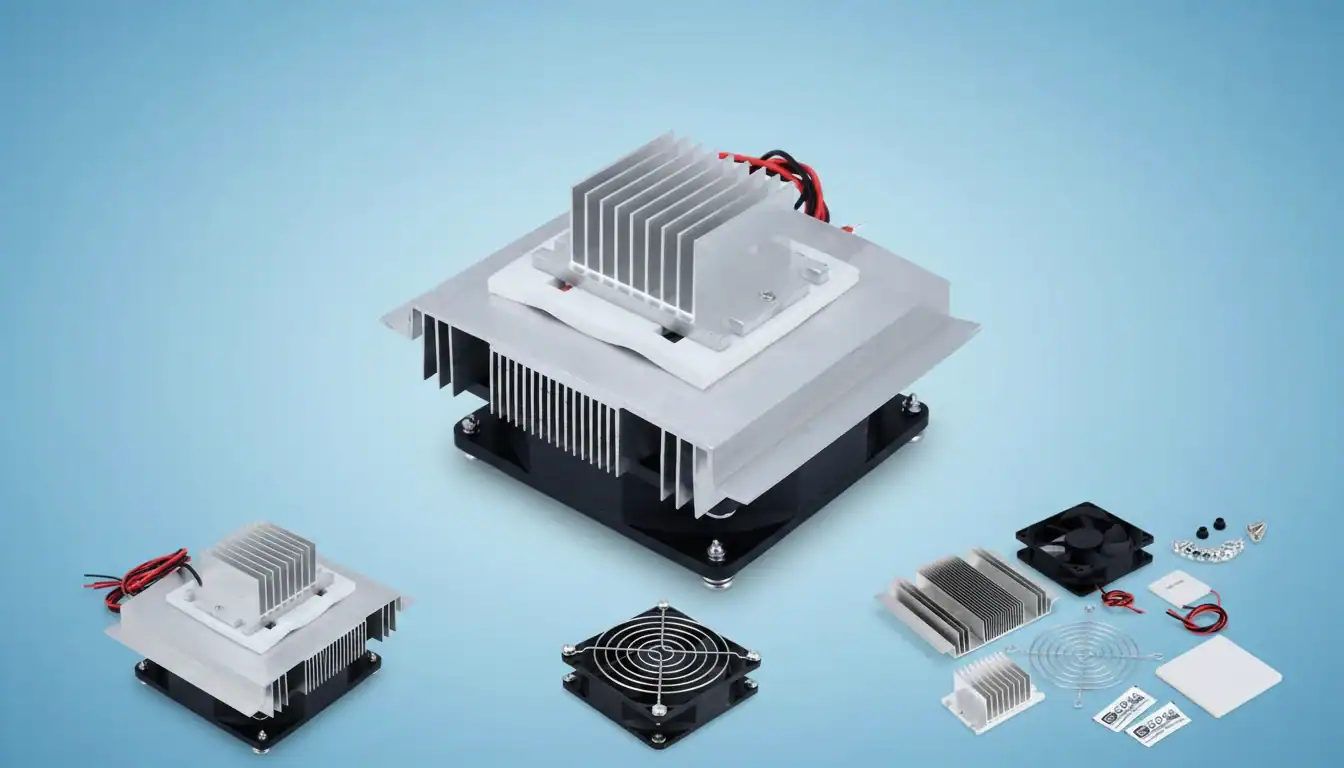
Reliability: Is the 30,000 Hour MTBF Valid for the Fan?
A fan’s 30,000-hour MTBF is a misleading metric that ignores mechanical wear. By that point, over 63% of units may have failed. L10 life is the better standard.
Why MTBF is a Misleading Metric for Fans
Mean Time Between Failures (MTBF) is a common spec, but it’s the wrong tool for measuring fan lifespan. The calculation is designed for electronic components with random, constant failure rates. A fan isn’t an electronic chip; it’s a mechanical device that predictably wears out over time.
The MTBF formula specifically excludes wear-out factors like bearing fatigue and lubricant breakdown. This creates a huge gap between the spec sheet and reality. A fan’s true mechanical lifespan is simply not part of the MTBF calculation. Statistically, the MTBF number only represents the point where 63.2% of a fan population has already failed. No one wants a product where nearly two-thirds of units are expected to be dead by the time they hit the advertised reliability rating.
L10 Life Expectancy: A More Accurate Measure of Durability
The industry standard for mechanical components like fans is L10 Service Life. This metric answers a much more practical question: how long will a fan run before failures start becoming common? L10 represents the time at which 90% of the fans in a given batch are still operating correctly.
Engineers determine L10 through accelerated life testing that directly measures bearing durability and lubrication performance under stress. This gives a realistic picture of service life. Our focus on ‘Silent Fan Tech’ for quiet operation depends on sourcing quality components. The reliability of these parts is better defined by L10 principles, ensuring they perform quietly and consistently for a predictable lifespan.
Frequently Asked Questions
Can we customize the retail box with a cooling performance guide?
Yes. We can print a guide on the retail packaging to help customers understand its performance. The guide will clearly state that the unit cools to 16°C – 20°C below the ambient room temperature. We will ensure all information is accurate and compliant with packaging regulations.
How long will the fan last if the unit is always on?
The fans are designed for long-term, continuous operation. We use quality bearings that ensure a lifespan of over 30,000 hours, which supports the product’s reliability and minimizes the need for replacements under the one-year warranty.
Is it safe to run the mini fridge 24/7 without it overheating?
Yes, the fridge is built for continuous operation. It features an integrated thermal management system with an active cooling fan that prevents the main board (PCB) and cooling chip from overheating, ensuring safe and reliable performance around the clock.
How much electricity does a skincare fridge use?
These units are very energy-efficient. A typical 4L to 6L model uses only about 27W-35W of power, which is less than a standard lightbulb. This low consumption makes it ideal for constant use in bedrooms or dorms without significantly impacting electricity costs.
Final Thoughts
Generic units that over-promise on cooling performance are a direct cause of customer returns. Our engineered 16°C–20°C standard manages expectations, protects your brand reputation, and prevents damage to sensitive skincare products. This commitment to physics-based accuracy is what separates a reliable product from a liability.
Validate our engineering for yourself. We recommend ordering a sample unit to test the cooling stability and silent fan operation firsthand. Contact our team to discuss Pantone matching and custom packaging options for your trial order.

 English
  Español
  Français
  Deutsch
  Português do Brasil
  Русский
  한국어
한국어  日本語
日本語  العربية