 跳转到主要内容 跳转到页脚
Procurement managers often face a choice between the convenience of cordless tech and the long-term reliability of a plug-in machine. Lithium-ion batteries represent 40% to 50% of a vacuum’s manufacturing cost, yet they eventually lose capacity and require expensive replacements. In small apartments or commercial studios, where cleaning sessions last 30 to 40 minutes, the unlimited runtime of a corded stick vacuum offers a more stable and cost-effective solution.
We examine the performance benefits of direct AC power, including how these units maintain a steady 15kPa suction without the thermal throttling found in battery-operated motors. You will also find a breakdown of cord management systems and an analysis of how skipping battery-related hazmat fees simplifies supply chain logistics for high-volume orders.
The “Battery Anxiety” in Small Spaces: Is it Necessary?
Cleaning a compact apartment or studio typically takes 30 to 40 minutes. While corded models provide infinite runtime, modern cordless packs offer 30 to 60 minutes of power in standard modes. For small spaces, battery anxiety is often more psychological than operational, though corded units offer more consistent suction stability.
Apartment Cleaning Cycles and Runtime Reserve
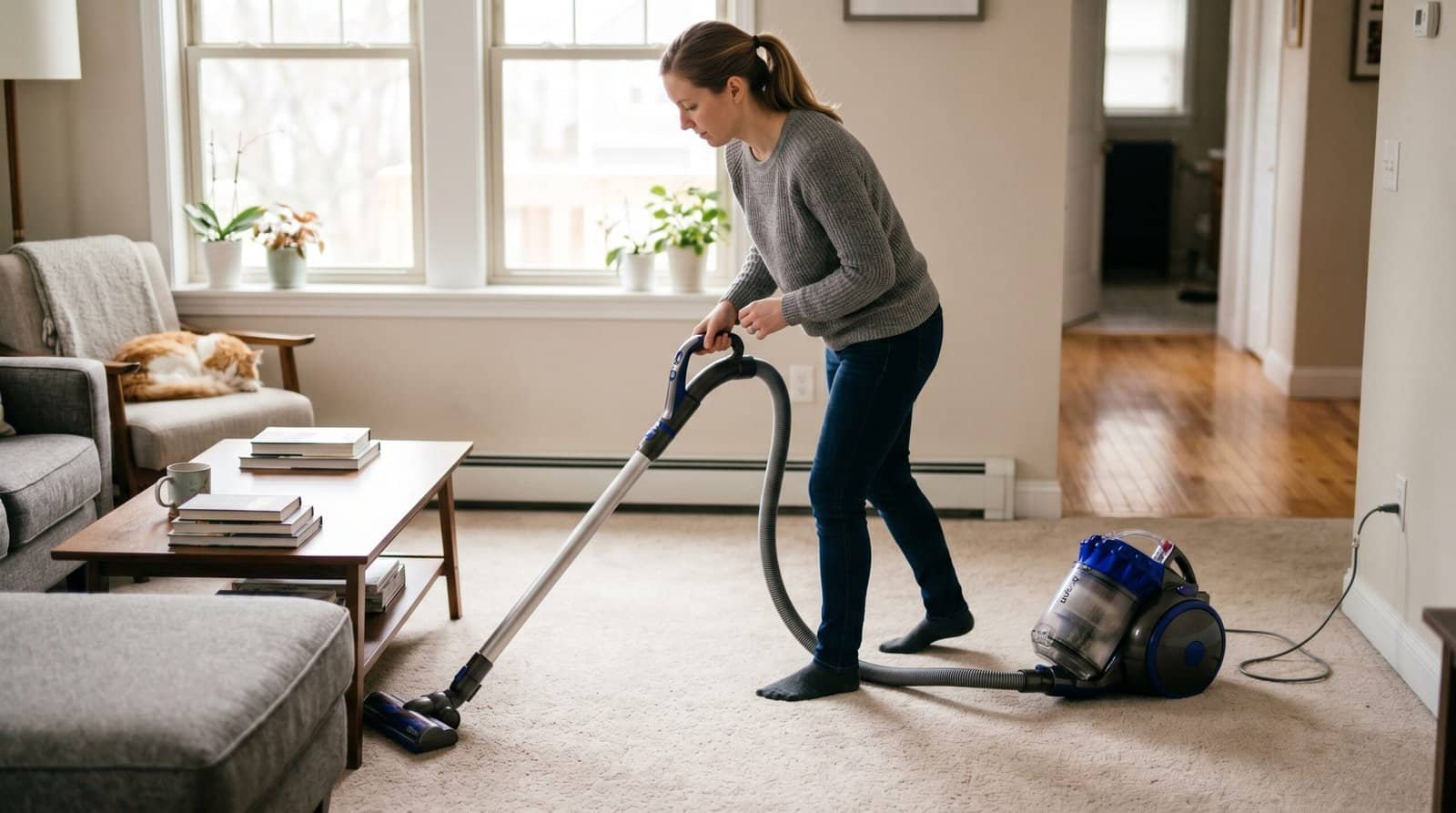
Recent cleaning studies show that active vacuuming in small apartments rarely exceeds 30 to 40 minutes per session. Mid-range cordless stick vacuums provide 30 to 60 minutes of runtime in eco or normal modes, which creates a sufficient buffer for compact floor plans. Most users in studios or one-bedroom units operate their machines in low-power modes because they primarily deal with hard floors. This maximizes battery life and reduces the risk of the vacuum shutting down before the job is done.
When a vacuum is correctly specified for the space, the probability of a mid-clean shutdown remains low. Manufacturers often target 45 to 60 minutes of rated runtime as the standard for “whole-home” cleaning, which means a small dwelling leaves plenty of energy in reserve. This buffer makes the cordless experience reliable for daily maintenance, though the need to manage charge levels remains a factor compared to the plug-and-play nature of corded alternatives.
Suction Stability and Thermal Power Throttling
Cordless lithium-ion packs experience voltage sag and thermal limits as they discharge. These physical constraints often force control electronics to throttle suction as the battery charge drops or the cells heat up. In contrast, corded stick vacuums maintain a constant suction profile because they pull directly from AC mains. Engineering tests show corded units reaching a steady 13-15 kPa and 33 m/s airflow at the wand, whereas cordless versions may see airflow drop to roughly 31 m/s or lower during extended use.
High-power or turbo modes on cordless units often last only 10 to 20 minutes, making the unlimited full-power delivery of corded models a quantifiable advantage for deep cleaning tasks. Corded models also eliminate the 3 to 5-hour recharge window required by typical Li-ion packs. Since many modern corded stick vacuums weigh less than 9 lbs, they offer maneuverability comparable to cordless models while providing the stability of constant, unthrottled power for more intensive cleaning sessions.
Cost Advantage: Corded Performance at Half the Price
Corded stick vacuums eliminate the lithium-ion battery, which typically represents 40% to 50% of a vacuum’s manufacturing cost. By using direct AC power, these units deliver 20,000Pa of constant suction without the price premium of battery management systems, making them ideal for high-volume B2B procurement.
| Component Category | Cost Impact | Suction Performance |
|---|---|---|
| Lithium-Ion Battery & BMS | Reduces cost by 40%–50% | Unlimited runtime |
| Power Architecture | Eliminates charging docks | Steady 20,000Pa rating |
| Supply Chain Logistics | Avoids hazmat shipping fees | Direct AC motor efficiency |
Battery Elimination as a Cost Reduction Strategy
Lithium-ion cells and Battery Management Systems (BMS) are the most expensive components in modern vacuums, often doubling the final unit price. KelyLands utilizes direct power configurations to bypass the need for expensive charging docks and specialized PCB assemblies. This engineering choice simplifies the supply chain, allowing for lower MOQs starting at 50 units for non-branded home vacuum models. Wholesale buyers save on hazardous material shipping fees since corded units do not require the strict certifications associated with lithium battery transport.
Maintaining 20,000Pa Suction Power Without the Price Hike
Home corded models achieve constant suction ratings up to 20,000Pa, matching the performance of cordless units that cost twice as much. AC-powered motors provide 100% suction strength from start to finish, so users avoid the performance drop common in battery-operated motors as voltage decreases. The simplified internal structure allows for 100% performance testing in the factory, ensuring safety and functionality without complex electronic failure points. Direct power designs reduce long-term maintenance costs because there are no battery cells to degrade or replace after the standard 500-cycle limit.
Suction Power: 15kPa Constant vs. Fading Battery
Corded stick vacuums deliver a reliable 15kPa suction by utilizing continuous power from 400W to 1300W motors. While cordless units experience performance decay as lithium-ion batteries lose voltage, corded models like the INSE R6 maintain peak airflow throughout the entire cleaning session, making them more effective for thorough floor maintenance.
| Vacuum Model | Motor Wattage | Key Specifications |
|---|---|---|
| INSE R6 / R6X | 600W | 15 kPa Suction, 0.8L Dust Cup, Carbon HEPA |
| Intercleaner | 400W | 15 kPa Suction, Ultra-Quiet, 12-in-1 Design |
| Liyyou LY1709 | 1300W | 15 kPa Suction, HEPA Allergy Protection |
Continuous Power Delivery and Suction Stability
Corded designs draw steady current from AC outlets, allowing models like the INSE R6 to hold a constant 15kPa rating without the 20-30% power loss typical of battery discharge curves. Constant suction ensures deep cleaning for pet hair and debris on hard surfaces and low-pile carpets. Battery-powered models often require “Max” modes that deplete runtime in minutes, whereas corded systems provide an uninterrupted workflow. Stable power input supports the 600W motor in maintaining high-velocity airflow even as the 0.8L dust cup fills with debris.
Impact of Motor Wattage and HEPA Filtration on Airflow
Vacuum models range from 400W ultra-quiet motors to 1300W high-output units like the Liyyou LY1709. Higher wattage correlates to stronger sustained airflow, which helps pull embedded dirt from floor crevices. Integrated HEPA media filters capture 99.99% of microparticles, preventing dust buildup in the motor housing that can restrict suction pressure over time. The combination of a 15kPa suction benchmark and efficient allergy protection filters ensures consistent performance for tile, hardwood, and laminate flooring throughout the life of the machine.
Scale Your Brand with Custom High-Performance Vacuum Cleaners

Cord Management: Hooks vs. Retractable Reels
Corded stick vacuums use manual hooks for budget-friendly simplicity or retractable reels for automated safety. Reels utilize steel torsion springs and ratchet systems to lock cables at specific lengths, whereas hooks require manual winding. By 2026, premium models favor retractable systems with NEMA-rated protection to prevent trip hazards and cable wear.
Mechanisms of Automatic Retraction vs. Manual Storage
Retractable reels utilize steel torsion springs and ratchet mechanisms featuring pawls and detents to lock the cord at multiple positions. Double-winding physics uses a midpoint cable attachment to reduce spring rotation by 50% relative to the extended length, which minimizes internal mechanical stress during use. This design ensures the internal components last longer even with daily extension and retraction.
Manual hooks support basic lift and drag operations but lack integrated tension control, increasing the risk of cable tangles and jacket abrasion over time. Coil springs hooked to a central hub provide the constant-tension payout required for smooth operation in high-traffic spaces. These mechanical systems automate cable organization, reducing the manual effort needed to maintain a safe cleaning environment.
Capacity Limits and NEMA Durability Standards
Consumer-grade retractable reels typically support 20 to 30 feet of 12-16 AWG cable rated for 10-15 Amps. Heavy-duty housing often meets NEMA 4 standards, ensuring the internal reel remains functional in indoor or outdoor wet locations. These specifications allow vacuums to operate safely across diverse flooring types without overloading the electrical circuit or damaging the internal wiring.
Low-friction four-roller cable guides minimize jacket wear during constant-tension payout and retraction cycles. Industrial-strength 16/3 SJT cables and 100% steel construction prevent degradation over 2,000 or more retraction cycles. Using these high-grade materials ensures the vacuum remains reliable for years, whereas plastic manual hooks often fail under high-impact conditions or repeated stress.

Longevity: No Battery Degradation over 5 Years
Corded stick vacuums bypass the chemical aging and capacity fade that typically limit cordless models. By drawing direct power, these units deliver stable performance throughout their 5-7 year mechanical lifespan, avoiding the performance drops and replacement costs associated with lithium-ion packs.
Structural Advantages Over Lithium-Ion Chemical Aging
Lithium-ion packs in cordless models suffer capacity fade from thermal stress and repeated charge cycles. This chemical degradation limits the effective lifespan of the entire machine. Corded designs eliminate the need for strict storage windows, which typically require temperatures between 18–28°C to prevent cell damage or motor blocking. By removing the battery, these vacuums avoid the vulnerabilities associated with energy density and power density trade-offs.
Manufacturers often limit cordless battery warranties to two years. This acknowledges that runtime will drop significantly after approximately 2,000 hours of use. High-power settings like Max or Boost mode specifically accelerate this aging process. A corded vacuum operates without these constraints, ensuring the power system does not fail before the mechanical components.
Consistent Output Across the 5-7 Year Lifespan
Stick vacuums typically last between five and seven years under standard household use. While cordless units may show runtime drops to 11–12 minutes on max power within two years, corded models maintain a stable 15kPa suction power throughout their service life. This stability stems from a direct electrical connection that does not weaken as the machine ages.
Removing the battery pack avoids depth-of-discharge stress. This stress often forces cordless users into expensive pack replacements before they reach the five-year mark. Corded sticks trade mobility for a reliable power delivery system that aligns with the mechanical durability of the motor, fan, and brushroll. This architecture ensures the vacuum remains functional until it reaches the end of its physical wear cycle.
Final Thoughts
Corded stick vacuums offer a practical solution for compact living where high-end cordless prices often exceed actual cleaning needs. These units provide stable suction and unlimited runtime without the risk of battery failure or performance drops during a session. In a studio or small apartment, the presence of a power cord is a small trade-off for a machine that costs significantly less and delivers consistent results every time it is plugged in.
Choosing corded technology prioritizes mechanical reliability and long-term value. Since these vacuums bypass the chemical aging of lithium-ion cells, they maintain their cleaning power for five to seven years without the need for expensive replacement parts. For users who want to simplify home maintenance, a corded stick vacuum ensures floors stay clean without the frustration of charging cycles or fading airflow.
Frequently Asked Questions
Does the vacuum include integrated cord storage like hooks or reels?
Corded stick vacuums usually feature integrated hooks or clips for cable management. Manual or spring-loaded reels remain rare in these specific designs because they add weight and bulk to models optimized for lightweight handling.
How does the motor lifespan of a corded vacuum compare to cordless alternatives?
Corded vacuums offer superior durability, typically lasting 8 to 10 years. In comparison, cordless units generally reach the end of their service life within 3 to 5 years, with data showing that 15% of battery-operated motors fail by year 5.
Will the unit overheat when used continuously in small or enclosed spaces?
These vacuums rarely overheat during standard operation. The simplified motor design and continuous power supply allow for 30 to 60 minutes of uninterrupted cleaning without the thermal shutdowns common in high-draw battery systems.

 English
  Español
  Français
  Deutsch
  Português do Brasil
  Русский
  한국어
한국어  日本語
日本語  العربية