OEM vs Private Label vs White Label Vacuum Cleaners
Compare OEM, private label, and white label manufacturing strategies for vacuum cleaners with insights for European distributors and market trends.
Reading Time:6 min
|
Word Count:1461
In the evolving landscape of vacuum cleaner manufacturing, distributors and online sellers face a strategic crossroads among OEM, private label, and white label approaches. This article provides an in-depth comparison of these manufacturing models tailored to vacuum cleaners, offering actionable insights for European appliance distributors and other key stakeholders, including the dominance of Chinese manufacturing and the critical role of sustainability.
Overview of Manufacturing Strategies for Vacuum Cleaners
Selecting the ideal manufacturing partnership—OEM, private label, or white label—is a critical choice that hinges on your specific business objectives, available resources, and the dynamics of your target market.
A selection of handheld vacuum cleaners, each designed for different cleaning tasks, displayed on a purple backdrop.
OEM Manufacturing: Customization Meets Control
OEM manufacturing provides the highest level of product design customization and control. You can develop vacuum cleaners with unique features and specifications that truly differentiate your brand in the marketplace. This path, however, demands a substantial investment in research and development and results in a longer time to market.
This approach is best suited for established companies with significant resources. Chinese manufacturers dominate global OEM vacuum production, accounting for an estimated 70-80% of output. Credibility in this space is built on stringent environmental compliance and quality certifications like ISO 9001:2015.
Private Label Manufacturing: The Strategic Middle Ground
Private label manufacturing allows you to sell high-quality devices under your own brand with moderate customization. It offers a compelling balance, delivering higher profit margins than white label solutions while requiring a more controlled upfront investment. This makes it the recommended path for retailers looking to expand their product lines without developing in-house manufacturing capabilities.
Successful collaborations often involve co-development of design and advanced features. China remains a leading destination for private label vacuum manufacturing due to its flexible minimum order quantities and robust supply chain capabilities, providing a reliable foundation for brand growth.
White Label Manufacturing: Speed and Simplicity
White label manufacturing is the fastest route to market. It utilizes pre-manufactured vacuum cleaners that are simply rebranded with your logo and packaging. This model requires minimal R&D investment, making it highly accessible.
The trade-off is limited product customization and lower profit margins compared to private label. It is especially suitable for startups and businesses prioritizing rapid market entry, often facilitated by low minimum order quantities that allow for a risk-controlled product launch.
Certification, Quality Assurance, and Sustainability as Competitive Differentiators
For distributors seeking lasting manufacturing partnerships, rigorous certifications, proven quality assurance, and a commitment to sustainability are non-negotiable elements that build trust and mitigate risk.
Manufacturing Certifications and Audit Compliance
Product certifications like CE, RoHS, and UKCA are essential for market access, ensuring safety and environmental compliance. Factory audits and certifications, including ISO 9001:2015, BSCI, TÜV Rheinland, and SGS, are equally critical for establishing a manufacturer’s credibility and operational standards.
Implementing a rigorous three-stage quality control process with 100% functional testing is standard for top partners. This significantly reduces failure rates and after-sales costs. Partnering with high-volume production sites also mitigates supply chain risks during seasonal demand peaks.
Key Certifications and Their Benefits
Certification
Scope
Competitive Advantage
CE
Product safety compliance in EU
Essential to access European markets
RoHS
Restriction of hazardous substances
Compliance with environmental regulations
UKCA
UK product conformity marking
Post-Brexit market access
ISO 9001:2015
Quality management system
Demonstrates manufacturing quality standards
BSCI
Business social compliance
Ethical sourcing and supplier credibility
TÜV Rheinland
Third-party testing and certification
Independent verification of compliance and quality
SGS
Third-party auditing
Independent verification of compliance and quality
Table Source: Industry compliance standards for appliance manufacturing.
Overview of various certifications for vacuum cleaners, including CE, CSA, UL, and Energy Star.
Sustainability Initiatives and Green Manufacturing
Growing consumer demand for eco-friendly appliances is a powerful market driver. Manufacturers are responding by adopting sustainable materials and designing for energy efficiency. Sustainability labeling and eco-conscious packaging are becoming key signals of brand responsibility.
Forward-thinking manufacturers leverage their technological expertise to optimize the entire product lifecycle for reduced environmental impact. Furthermore, global regulatory trends are increasingly favoring products with reduced toxic components and enhanced recyclability, shaping the future of vacuum cleaner design.
Keep your vehicle spotless with KelyLands’ powerful, quiet, and compact car vacuum cleaners. Designed for ease and versatility, they include multiple attachments, fast USB-C charging, and washable filters. Customize colors, logos, and packaging to match your brand’s needs.
Market Segmentation and Strategic Partnership Approaches
A one-size-fits-all strategy fails in manufacturing. Aligning your approach with the specific needs of your distributor segment is key to unlocking competitive advantage and building customer loyalty.
European Appliance Distributors: Reliability and Compliance
This segment is highly focused on supplier credentials and consistent certification. They prioritize long-term partnerships with factories that are fully certified (CE, RoHS, UKCA) and regularly audited (ISO, SGS, TÜV Rheinland). Proven quality assurance processes, like triple quality inspection, are fundamental to their decision-making.
Beyond compliance, they value collaborative design partnerships with strong IP protection measures like NDAs. They are often interested in product innovation, seeking customizable features such as improved batteries and specialized attachments.
North American E-Commerce Sellers: Speed, Flexibility, and Profit Margins
This agile segment requires low minimum order quantities—sometimes as low as 50 units—with flexible customization options kicking in around 300+ units. Their success is heavily dependent on robust marketing assets, including high-quality product data sheets, images, and videos to optimize their online listings.
They demand distinctive product features like dual suction and high suction power (e.g., 13,000Pa) to stand out in a crowded marketplace. Support for platform-specific logistics, such as Amazon FBA and Shopify, is a critical value-add from their manufacturing partners.
Home Lifestyle Brands: Design, User Experience, and Brand Identity
For these brands, design quality, branding consistency, and consumer-centric features are paramount. They invest in aesthetically pleasing and often eco-friendly packaging, including premium gift boxes. Their product requirements emphasize advanced features that enhance usability, such as quiet operation (<80dB) and fast USB-C charging.
They seek manufacturers who offer strong IP confidentiality and true co-development support. Leveraging a manufacturer’s R&D team capable of launching multiple innovative models annually is a significant advantage for these brands.
Large Retail Chains and Supermarkets: Scale, Cost, and Risk Mitigation
This segment places critical importance on sheer manufacturing scale, seeking partners with monthly outputs exceeding 100,000 units and annual capacities over 1 million units. Stringent regulatory certifications are a baseline requirement to evidence supply chain security and mitigate risk. Their focus is on highly competitive pricing with a strong emphasis on the total cost of ownership, which includes managing returns and warranty claims.
They require extremely flexible packaging and fulfillment capabilities to effectively manage volatile seasonal demand. Vendors with robust warehousing and logistics operations capable of sustaining high volume are strongly preferred.
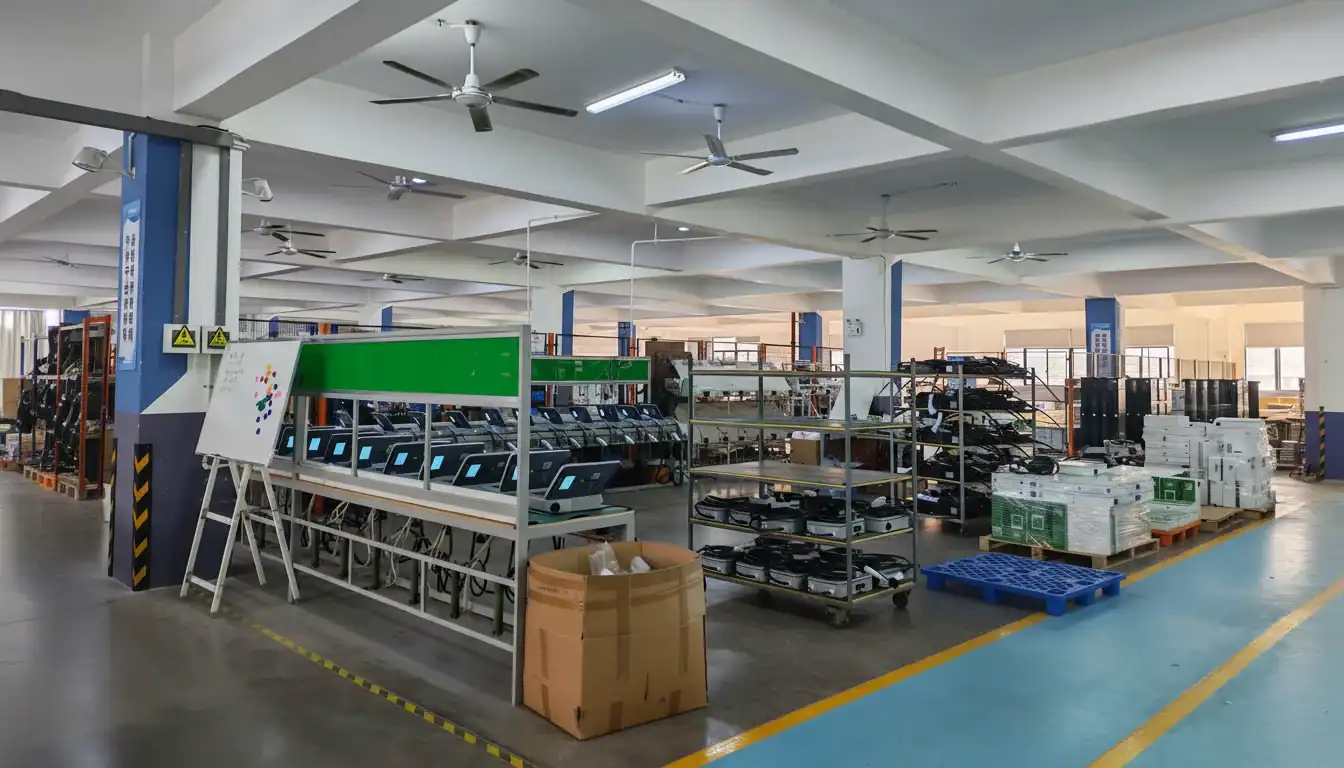
Modern factory floor featuring organized shelves and equipment, highlighting an efficient workspace.
The article explains that OEM manufacturing allows full customization and control but requires significant investment and time. Private label offers moderate customization with higher margins and a more manageable investment. White label delivers the fastest market entry with minimal investment but offers low customization and margins.
How does product certification influence partnership decisions for European distributors?
Certificates such as CE, RoHS, and UKCA are crucial for product safety and environmental compliance. Factory audits like ISO 9001:2015, SGS, and TÜV Rheinland are highlighted as vital trust-building credentials. These are often required to risk-manage suppliers and ensure both quality and regulatory compliance.
Why is automation and software important for lab scheduling in pharmaceutical quality control environments?
Automation minimizes manual scheduling errors and optimizes assignments based on analyst qualifications and workload. It also manages dynamic sample priorities and enables real-time scheduling adjustments. This is critical to maintaining cycle times and ensuring timely delivery.
How does the lifecycle approach to process validation differ from traditional views?
The lifecycle approach views process validation as an ongoing set of activities including design, qualification, and continuous verification with data-driven decisions. This differs from the traditional view of it as a one-time event. The lifecycle method improves process understanding and adaptability.
What role do trade shows and digital platforms play in sourcing private label manufacturers?
Trade shows provide opportunities for face-to-face vetting and innovation discovery. Digital B2B platforms facilitate efficient supplier identification, product comparisons, and project management. Both are instrumental in streamlining private label product development.
Hi, I’m Hanke Chen, the Head of KelyLands Sales Team. With over a decade of experience as a sales engineer, I bring in-depth expertise in the design, production, and sales of car accessories.
Please leave your information here, our team will get back to you soon..
WhatsApp us
We use cookies to ensure that we give you the best experience on our website. If you continue to use this site we will assume that you are happy with it.
 跳转到主要内容 跳转到页脚





 English
  Español
  Français
  Deutsch
  Português do Brasil
  Русский
  한국어
한국어  日本語
日本語  العربية