 跳转到主要内容 跳转到页脚

Navigating the strict material regulations for 2. Silicone & Plastics(bpa free travel kettle) determines whether your shipment clears customs or faces a costly compliance recall due to chemical leaching. Buyers face constant pressure to source safe components that withstand high-temperature boiling without releasing harmful endocrine disruptors into drinking water. Relying on cheap manufacturing shortcuts often results in failed European LFGB tests and a persistent factory odor that destroys consumer trust and triggers massive return rates.
This technical breakdown examines why budget materials fail rigorous European testing and how factory teams eliminate off-gassing odors before products leave the assembly line. We provide a clear operational standard for validating material safety against extreme heat and detail the exact production parameters you need to customize collapsible components to your specific color requirements.
Why Do Cheap Silicone Kettles Fail the European LFGB Test?
The strict European LFGB testing protocols actively expose budget kettles by detecting hazardous plastic fillers, heavy metals, and volatile organic compounds that degrade under boiling conditions.
The Use of Toxic Fillers and Heavy Metals
Budget manufacturers reduce material expenses by blending unapproved chemical compounds into their silicone base. Low-quality silicone batches rely on plastic fillers that break down and release harmful toxins when exposed to boiling water. Chemical analysis of cheap models frequently detects heavy metals, such as lead or cadmium, alongside synthetic dyes not approved for food contact.
KelyLands engineers its 12V/24V car kettles to meet global market requirements by completely avoiding hazardous fillers and prioritizing pure, food-safe components.
The High Cost of Platinum-Cured Silicone
The German Food, Commodities and Feed Act (LFGB) sets stringent material standards that budget factories typically bypass. Meeting the strict 2026 European LFGB standard requires platinum-quality silicone, a premium grade that maintains structural integrity under extreme heat. Sourcing this premium material increases production costs by 5% to 15% compared to FDA-only alternatives, pushing budget brands toward lower-grade, non-compliant options.
| Testing Metric | Budget Silicone (Uncertified) | LFGB Platinum Silicone |
|---|---|---|
| Silicone Grade | Peroxide-cured with plastic fillers | 100% Platinum-cured |
| Heavy Metal Content | Often contains lead or cadmium traces | Zero heavy metal detection |
| Material Cost Impact | Baseline (Low production cost) | 5% to 15% higher procurement cost |
KelyLands leverages its massive Yuyao factory infrastructure to bulk-source LFGB-compliant materials, keeping wholesale pricing competitive for B2B procurement managers.
Failing Sensorial and Migration Testing
Inferior silicone kettles consistently fail the rigorous high-temperature testing protocols required for European market entry. LFGB testing mandates comprehensive plastic migration analysis using food simulants at high temperatures to simulate real-world boiling conditions.
Cheap silicone off-gasses volatile organic compounds (VOCs) during the heating cycle, causing unacceptable odor and taste transfer into the drinking water. Compliant products release only negligible trace elements that stay far below European safety thresholds, ensuring the water remains completely safe for long-haul drivers and outdoor users.
Does High-Temp Boiling Release Endocrine Disruptors in Plastics?
Elevated heat physically alters the polymer matrix of plastics, exponentially accelerating the migration of endocrine-disrupting chemicals like antimony and nonylphenol into liquids.
Temperature Thresholds for Chemical Migration
At lower temperatures between 4°C and 10°C, endocrine-disrupting chemicals (EDCs) like bisphenol A (BPA), phthalates, and nonylphenol remain firmly locked within the plastic structure, keeping detectable levels below analytical limits. As heat increases, chemical migration accelerates rapidly. In polyethylene terephthalate (PET) containers, antimony concentrations reach 6 parts per billion (ppb) after 12 days at 70°C. Push that temperature to 80°C, and the liquid absorbs the same 6 ppb in just 2.3 days. Constant exposure at 80°C for seven days drives antimony levels up to 14.4 ppb.
Plastic Variations and Leaching Rates
The specific composition of the polymer directly determines the volume and speed of EDC release under high heat. Polypropylene (PP) containers release significantly higher concentrations of EDCs compared to general-purpose polystyrene (GPPS) across all tested temperature ranges. Both materials leach compounds like DEHP and nonylphenol, but PP demonstrates a much higher leaching rate under the extreme heat required for brewing hot beverages.
| Material Type | Temperature Exposure | Chemical Migration Result |
|---|---|---|
| PET (Polyethylene Terephthalate) | 80°C for 7 Days | 14.4 ppb Antimony Release |
| PP (Polypropylene) | Boiling Temperatures | High DEHP & Nonylphenol Release |
| High Borosilicate Glass (SM400 Series) | Extreme Thermal Shock / Boiling | 0% Chemical Migration (Zero Odor) |
To bypass these material vulnerabilities, manufacturers engineer premium alternatives. KelyLands constructs their SM400 series 12V/24V car kettles using High Borosilicate Glass and LFGB-certified components, guaranteeing zero chemical migration and eliminating the notorious plastic taste entirely.
Material Breakdown and Fluid Interactions
Boiling temperatures inflict physical stress on plastic containers by increasing chain mobility within the polymeric matrix. This structural shift allows trapped chemical contaminants to escape and diffuse directly into the liquid. The composition of the beverage further dictates the severity of this chemical migration. Acidic fluids like soda or vinegar act as catalysts, forcing significantly higher rates of EDC migration than neutral liquids like purified water.
Source Premium 12V/24V OEM Car Kettles Today
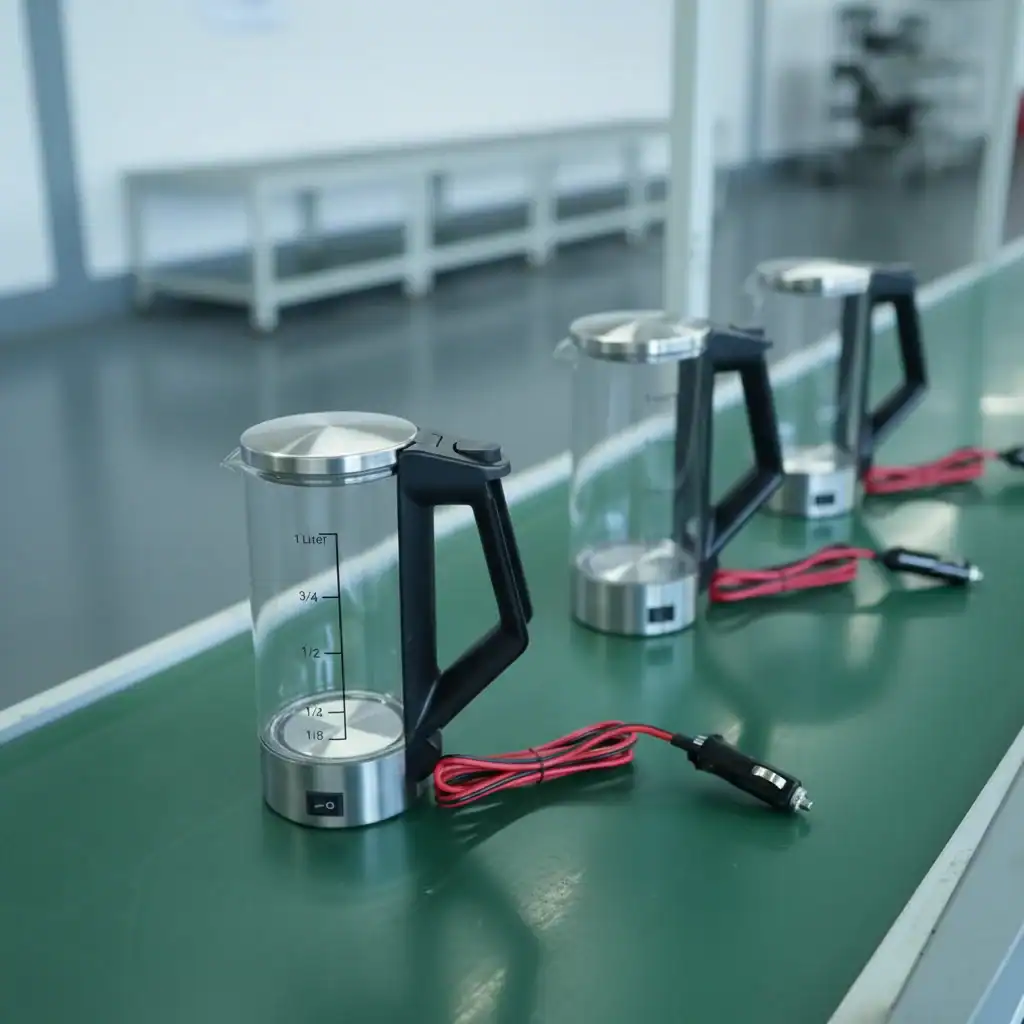
How Does the Factory Eliminate the “New Plastic Smell” Before Shipping?
Industrial odor elimination relies on advanced thermal volatilization and molecular adsorption rather than masking agents, ensuring food-grade compliance and consumer safety right out of the box.
Mechanical and Thermal Processing
Facilities eliminate volatile organic compounds (VOCs) at the very beginning of the production cycle through mechanical and thermal intervention. Operators shred, wash, and dry the raw polymer materials to strip away surface impurities and loose contaminants. Once cleaned, targeted thermal treatment volatilizes and drives off odorous compounds before the plastic enters the injection molding phase.
KelyLands mandates that all plastic components and the High Borosilicate Glass used in its 12V and 24V DC car kettles undergo this rigorous thermal processing. This structural approach guarantees the final product strictly meets LFGB and CE safety standards without retaining residual manufacturing scents.
Adsorption and Odor-Scavenging Additives
To neutralize smells from the inside out, manufacturers integrate specialized compounds directly into the raw plastic matrix. Facilities deploy activated carbon compounds that actively trap volatile organic compounds within the polymer structure. Engineers also incorporate specialized odor-scavenging masterbatches designed to encapsulate odor molecules, physically preventing them from escaping the finished product.
This precise additive method maintains the absolute structural integrity of the plastic casing. It secures consumer safety for food-grade in-car appliances, allowing drivers to heat water for beverages or baby formula entirely free from chemical off-gassing.
Advanced Extraction and Chemical Treatments
Production lines deploy chemical oxidizers and pressurized water systems to tackle stubborn odors without relying on harmful organic solvents. Specific oxidizing agents break down and chemically neutralize residual odor-causing contaminants at the molecular level. Following oxidation, pressurized water extraction strips out any remaining smells, providing a highly effective, eco-friendly alternative to harsh industrial solvents.
KelyLands enforces a strict triple-layer quality control protocol encompassing Incoming Quality Control (IQC), Process Quality Control (PQC), and Final Quality Control (FQC). This rigorous inspection verifies that all shipping units, from heavy-duty 24V commercial kettles to 12V passenger models, arrive completely free of chemical odors and ready for immediate deployment in logistics fleets and RVs.
Can We Customize the Pantone Color of the Collapsible Silicone?
KelyLands integrates the Pantone Matching System with LAB color analytics to guarantee exact color replication across all silicone hardness levels for your brand.
The Pantone Matching System and LAB Color Accuracy
We use the Pantone Matching System (PMS) alongside the LAB color system to lock in precise shades for your brand identity. Our production team deploys advanced spectrophotometric measurement techniques to confirm color accuracy on every batch directly on the factory floor. This exact measurement protocol stops visual variations between different production runs and maintains strict visual consistency for your inventory.
Maintaining Consistency Across Silicone Formulations
Different material hardness levels demand precise blending to maintain visual uniformity. We adjust pigments at the chemical level when working with varying silicone hardnesses or specific LFGB-compliant formulations. The engineering team tightly controls the compounding process to keep the color solid and consistent across the main kettle body and all smaller silicone components. You secure a uniform aesthetic across your entire product line, even when combining distinct structural materials.
Minimum Order Requirements for Custom Colors
KelyLands aligns custom color production with standard B2B wholesale order volumes to optimize factory efficiency. Customizing your silicone kettle with a specific Pantone color requires a standard OEM minimum order quantity (MOQ). OEM branding and custom color runs typically start between 100 and 500 units, depending on the specific model and raw material setup. These bulk order requirements support the dedicated machine calibration, tooling adjustments, and pigment blending necessary to achieve an exact match.
Conclusion
Navigating the differences between FDA and European LFGB standards ensures your travel kettles meet strict safety requirements and avoid releasing harmful chemicals during high-temperature boiling. Sourcing compliant materials directly impacts product longevity and protects your brand from high return rates caused by lingering plastic odors or material failures. Prioritizing certified manufacturing processes gives importers peace of mind when distributing across strict regulatory markets.
Review your current procurement requirements to verify your kettle inventory aligns with regional compliance standards. Contact the KelyLands team to request a material safety report or to order a sample of our certified travel kettles.
Frequently Asked Questions
Do your silicone travel kettles have FDA and LFGB certificates?
Yes, our silicone travel kettles are fully certified to both FDA and strict LFGB standards. We utilize premium platinum-quality silicone to ensure compliance with comprehensive LFGB requirements, which include rigorous sensorial, plastic migration, metal composition, and silicone resin testing. This guarantees our products release no harmful substances when heated.
How do you remove the plastic smell from a new kettle?
To eliminate any residual manufacturing odors, fill the kettle to the maximum line with a mixture of water and two tablespoons of white vinegar or lemon juice. Bring the solution to a boil, let it sit for 15 to 20 minutes, and then discard the water. Rinse thoroughly and boil one more batch of plain water to ensure the kettle is completely neutralized and ready for daily use.
Is collapsible silicone safe for boiling water daily?
Yes, collapsible silicone is absolutely safe for daily boiling when constructed from high-quality, LFGB-certified materials. Premium platinum silicone is engineered to withstand constant high-temperature fluctuations without degrading or leaching plastic fillers, heavy metals, or volatile organic compounds into your drinking water.
What is the MOQ for a custom Pantone silicone kettle?
The standard Minimum Order Quantity (MOQ) for a custom Pantone-matched silicone kettle is typically 1,000 units. This volume allows us to precisely calibrate food-grade, LFGB-approved synthetic dyes to your exact brand colors while maintaining strict safety certifications and manufacturing efficiency.

 English
  Español
  Français
  Deutsch
  Português do Brasil
  Русский
  한국어
한국어  日本語
日本語  العربية