 跳转到主要内容 跳转到页脚

Day 1 the order is placed. Day 14 the pre-production sample arrives, and the cosmetic fridge OEM cost looks like a win. Day 45 the container lands and proves otherwise — the mass production run has a different surface finish, a looser lid fit, and a thermoelectric chip that runs noisier than the sample.
A $50,000 private-label order can go sideways at that exact point. Most buyers approve a physical sample and skip the written standard. That is how “this is not what I approved” turns into “this is within normal production variation.” Sample approval needs to include quality tolerance limits — color shift, hinge alignment, internal temperature range — before the line starts.
The cost conversation matters just as much. Mold fees for a 4L cosmetic fridge shell typically run $3,000 to $8,000 depending on cavity count. Many factories will amortize those fees into the unit price once you pass a set volume. FOB Ningbo pricing adds another lever: a port-side factory saves $8–12 per unit in domestic freight versus inland suppliers, so the price breakdown deserves more attention than the headline number.
Cosmetic Fridge Pricing Components
Mold fees set your landed cost.
The true cost of a private label cosmetic fridge hides in three places: the injection mold, the cooling system, and the packaging. Most buyers compare landed unit prices first, then discover the tooling charge was the difference between a viable launch and a margin disaster.
Injection mold cost for ABS shell and internal liner
A 4L cosmetic fridge shell mold typically lands between $3,000 and $8,000, depending on cavity count. A single-cavity mold keeps the initial investment low but limits daily output. A two-cavity mold roughly doubles throughput and lowers per-unit mold amortization once your order volume climbs past a few thousand units.
The internal liner is a separate mold. Many buyers assume the shell and liner share tooling — they do not. The liner needs its own draft angle and wall-thickness design because it sits directly against the thermoelectric module. Budget it as its own line item, or ask the factory to consolidate both molds into one quoted package.
-
- Mold fee amortization: Ask if the factory can fold the mold cost into unit price after a set order volume. That converts a lump $5,000 charge into a per-unit adder you can model against landed cost, instead of paying it all before the first container ships.
- Cavity count trade-off: A single-cavity mold suits launch batches under 1,000 units. A two-cavity mold only pays off with repeat orders; otherwise you are financing idle tooling capacity.
Compressor vs. thermoelectric chip unit cost
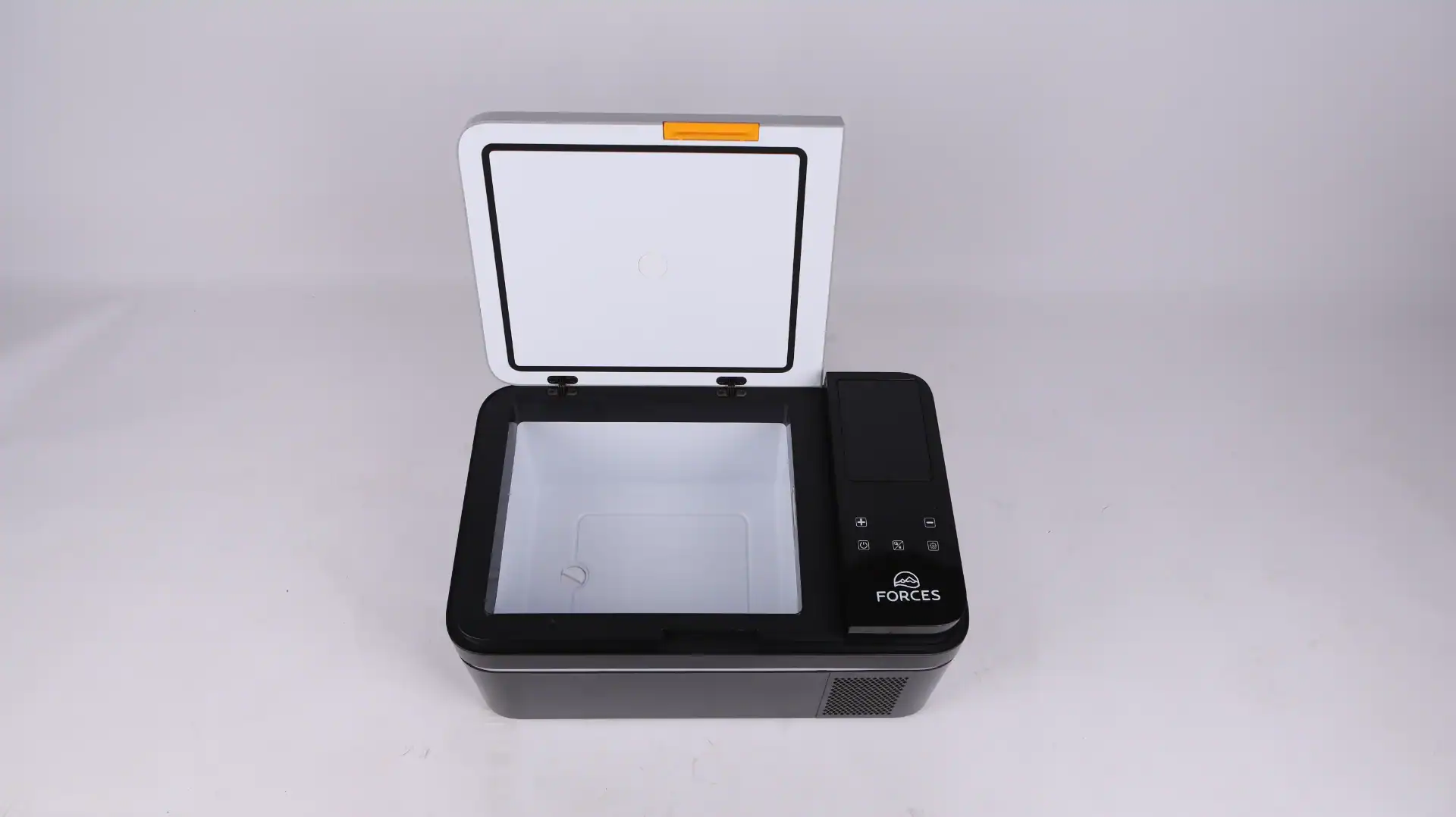
The cooling system splits the market into two price tiers. Thermoelectric units run roughly 30% cheaper than compressor units, which is why most 4L–10L cosmetic fridges on Amazon use them. But they only cool 10–15°C below ambient — in a 30°C room, your product sits at 15–20°C, not the 8–12°C range that temperature-sensitive serums and vitamin C formulations need.
Compressor-based fridges hold a stable 8–12°C regardless of room temperature and justify a higher unit price for premium skincare lines. The trade-off is noise, weight, and a more complex supply chain. Since 2018, KelyLands has sourced portable fridges through its Ningbo factory partnerships, so the sales team can pull real lead-time data for both cooling types instead of guessing.
Packaging, branding, and user manual costs
Packaging is not a rounding error on a cosmetic fridge PO. A 4-color printed gift box, foam inserts, and a brand-stickered unit can cost as much as the thermoelectric module in some configurations. Certification labels for electronics — CE, FCC, or UKCA — must be finalized before the artwork goes to print, not after. Changing a label post-production means reprinting every box and manual.
Request a quote with FOB Ningbo terms. The factory sits in Cixi, roughly an hour from Ningbo Port, which cuts domestic freight by $8–12 per unit compared to inland suppliers. On a 500-unit first order, that is $4,000–$6,000 in logistics savings you can reinvest into better packaging or a second mold cavity.
Typical MOQ Ranges by Fridge Type
The 4L thermoelectric min order sits at 500 units; compressor units start at 300.
Minimum order quantities for cosmetic fridges split cleanly by cooling technology. A 4L thermoelectric model starts at 500 units and pushes toward 1,000 units once you add custom colors and logo molding. A 10L compressor-based unit starts at 300 units because the bill of materials is higher, so fewer pieces cover the factory’s setup cost. Ask early whether the factory can fold mold fees into the unit price after a volume threshold — that changes which minimum actually makes sense for your cash flow.
4L thermoelectric cosmetic fridges: 500–1,000 units
Thermoelectric fridges use a semiconductor chip and a heat sink with no refrigerant loop. The ABS shell tooling is straightforward, but the unit price is low. At 500 pieces, the factory earns back the line setup and color changeover time. Drop below that and the math for an Amazon or Shopify launch no longer works on a private-label margin.
The bigger factor is how the fridge handles temperature. Thermoelectric units run roughly 30% cheaper than compressor units but only cool 10–15°C below ambient. That is fine for a nightly moisturizer drawer, not fine for vitamin C serums and retinol that need a stable 8–12°C band. Know which skincare formats you plan to stock before choosing the lower-cost route.
10L compressor fridges: why the minimum drops to 300
A 10L compressor fridge is a different production animal. Sealed refrigeration lines require charging stations, leak checks, and extended run-in testing. The higher unit price means the factory only needs 300 units to justify the same setup work. For a beauty subscription box or a premium skincare brand, the per-unit margin supports this route even though the initial cash outlay is steeper.
Compressor units hold a set temperature regardless of the surrounding room. That matters more than the 30% price gap when your customer keeps the fridge in a warm warehouse or a sunny bathroom. If a retailer returns units because serum degraded, the saved unit cost disappears instantly.
Ask about batching before you accept a low minimum
If a supplier quotes a 200-unit minimum on a custom thermoelectric shell, ask how the production line will run. Some factories batch your parts with another brand’s order to fill the shift. That means your color approval date no longer controls the schedule, and sample approval can drift by weeks. A 500-unit minimum with a dedicated color run often delivers faster and more consistent units.
-
- Approved route: KelyLands produces fridges through a Ningbo partner factory established in 2018, which keeps quotes on FOB Ningbo terms. Cixi sits near Ningbo Port, saving $8–12 per unit in domestic freight versus inland suppliers.
- Certification handling: Confirm whether electrical safety and EMC testing costs sit inside the unit price or as a one-time quotation line. Excluding them drops the landed cost per unit, but surprises appear before first shipment.
Use 500 units for a 4L thermoelectric launch and 300 units for a 10L compressor line as your baseline. Then compare quotes line by line: cooling technology, FOB port, certification fees, and packaging. Those four lines decide whether your first private-label run makes margin.
| Fridge Type | MOQ Range | Technology | Key Notes |
|---|---|---|---|
| 4L Thermoelectric Cosmetic Fridge | 500–1000 units | Thermoelectric chip | 30% cheaper per unit; cools 10–15°C below ambient |
| 10L Compressor-Based Fridge | 300 units minimum | Compressor | Stable 8–12°C cooling for premium skincare lines |
Cost Reduction Strategies
Skip the custom shell on your first run.
The fastest way to reduce cosmetic fridge pricing is to stop paying for a new mold every time you want a different color. A 4L cosmetic fridge ABS shell mold runs $3,000 to $8,000 depending on cavity count. Ask if the factory amortizes that mold fee into the unit price after an agreed volume.
Share molds across color variants
Color does not require a new shell mold. The injection mold defines the shape; the color comes from resin additives or a secondary paint step. Most factories can run pink, white, and black versions on the same mold. Keep your branded label and carton on the outside, and one mold serves multiple SKUs.
-
- Mold amortization: Request a quote that folds the mold fee into the unit price after a set volume. That keeps your first order from carrying $8,000 of tooling cost.
- Cavity count: A single-cavity mold lowers the upfront fee but raises cycle time. A two-cavity mold costs more initially and lowers per-unit cost once volume passes a few thousand units.
Order during off-peak production months
Ask the supplier to show a production calendar before you commit. Factories in Ningbo build around seasonal demand, especially for car fridges tied to automotive tourism and camping. Place a private label run in a quiet window, and you get better attention on sample approval and faster delivery.
KelyLands invested in a Ningbo-based portable fridge factory to serve that camping-driven demand. Scheduling a new SKU outside the peak season means the same production line and quality tolerance checks are available without racing other orders.
Use existing factory shell designs for the first run
A proven factory shell is your lowest-cost entry. The tool is already debugged and the mass production process has been validated. You bypass the $3,000 to $8,000 mold fee and spend that budget instead on packaging, photography, and listing optimization.
Thermoelectric units run about 30% cheaper than compressor units, and they cool 10–15°C below ambient. For skincare products that need a stable 8–12°C range, that works in a standard room. For a garage, a van, or a sunlit storefront, the compressor version may be the safer call.
For a beauty subscription box pilot, a 500-unit run on an existing shell design beats a 1,000-unit custom-color run that ties up cash in tooling. The standard starting range for a 4L thermoelectric fridge sits at 500 to 1,000 units, so a stock shell lets you stay at the low end without asking for a special exception.
Finally, ask for a quote on FOB Ningbo terms. Port proximity can cut domestic freight by $8–12 per unit compared with an inland supplier. For a 4L white-label fridge shipped in 500-unit batches, that difference alone funds your packaging upgrade. Also confirm whether certification costs are included in the quotation or added later.
Strip every line item that does not help the customer press “buy now.” A custom shell, a new mold, and inland freight all fall into that category on a first run.
| Strategy | Implementation | Cost Impact | Best For |
|---|---|---|---|
| Share Molds Across Color Variants | Use one ABS shell/inner liner mold and produce multiple colors across 2-3 SKUs; negotiate multi-cavity tooling. | Eliminates duplicate mold fees; spreads the $3,000-–$8,000 tooling cost across variants. | Color-coordinated beauty fridge product lines |
| Order During Off-Peak Production Months | Place first PO between November and March when factory capacity is open; confirm off-peak scheduling with supplier. | Typically 3–7% lower per-unit pricing and shorter lead times. | Sellers planning 2026 launches with flexible timing |
| Use Existing Factory Shell Designs for First Run | Select a standard 4L thermoelectric shell from factory catalog instead of custom tooling; skip mold investment. | Saves the $3,000–$8,000 mold fee; MOQ stays at 500–1,000 units. | First-time private label makeup fridge brands |
| Amortize Mold Fee Into Unit Price | Ask the factory to fold mold cost into per-unit pricing after a committed order volume (e.g., 1,000 units). | Lowers upfront cash outlay; makes unit economics predictable. | E-commerce brand builders with limited pre-launch capital |
| Request FOB Ningbo Terms | Work with a Ningbo-based factory or supplier with port proximity; request a full FOB Ningbo pricing breakdown. | Saves $8–12 per unit on domestic freight versus inland suppliers. | Amazon sellers and volume importers |
| Use Thermoelectric Over Compressor for 4L Models | Specify a thermoelectric cooling chip for 4L cosmetic fridges; use compressor only for 10L+ models. | Reduces per-unit cost by ~30%; cools 10–15°C below ambient, maintaining 8–12°C for skincare. | Beauty subscription boxes and private label skincare brands |

Conclusion
Cosmetic fridge OEM cost breaks down into three numbers: mold investment, cooling technology, and freight terms. Thermoelectric units cost about 30% less than compressor models but only cool 10–15°C below ambient, which decides whether your skincare products hold the required 8–12°C range. FOB Ningbo terms also matter—port proximity trims $8–12 per unit in domestic freight versus inland suppliers.
-
- 4L cosmetic fridge mold fees range from $3,000 to $8,000 depending on cavity count; ask about amortization.
- Thermoelectric units run 30% cheaper than compressor models but only cool 10–15°C below ambient.
- FOB Ningbo pricing trims $8–12 per unit versus inland suppliers due to port proximity.
- Typical MOQ sits at 500–1000 units for 4L thermoelectric fridges; 10L compressor models start at 300.
Before you approve a quote, compare your target shelf temperature against the cooling specs in each supplier’s sample report—that single check filters out factories that cannot hold 8–12°C. Then request FOB Ningbo pricing from at least two manufacturers and ask whether mold costs can be amortized into the first production run. Browse the cosmetic fridge category page to review shell designs and MOQ terms that fit a first private-label order.
Frequently Asked Questions
What makes up cosmetic fridge OEM cost?
Cosmetic fridge OEM cost has three main parts: injection mold fees for the ABS shell and internal liner, compressor or thermoelectric chip unit cost, and packaging, branding, and manual costs. Mold fees are. Request a full cost breakdown before comparing unit prices.
What is the MOQ for a cosmetic fridge?
MOQ depends on the fridge type: 4L thermoelectric units typically start at 500–1000 pieces, while 10L compressor models require a 300-unit minimum. If you are testing demand, a smaller thermoelectric run is. Ask the factory to quote MOQ against your target capacity.
How can I reduce cosmetic fridge OEM cost?
Reduce cost by sharing one mold across color variants, ordering during off-peak production months, and using an existing factory shell design for your first run. Avoid custom shell. Use an existing shell for the pilot run and go custom after volume grows.
How much does a cosmetic fridge mold cost?
Mold fees vary with shell size, ABS wall thickness, and internal liner complexity, so no standard figure fits all cosmetic fridges. Expect compressor-based models to carry higher mold costs than thermoelectric. Get a mold quote after locking the shell and liner specs.
Should I start with thermoelectric or compressor cosmetic fridge?
Start with thermoelectric if you want a lower unit cost and a smaller 500–1000 piece MOQ. Choose compressor if your target buyers need stronger cooling and you can commit to the 300-unit minimum on. Match cooling performance to buyer expectations before deciding.

 English
  Español
  Français
  Deutsch
  Português do Brasil
  Русский
  한국어
한국어  日本語
日本語  العربية