 跳转到主要内容 跳转到页脚

Every sourcing guide you read will tell you to start your private label car fridge launch by getting three quotes and comparing FOB pricing. That advice is how a buyer ended up sitting on a $50,000 order where the pre-production sample looked perfect, but the mass production run showed up with a compressor that couldn’t hold -5°C in direct sun. The gap between sample approval and factory output isn’t about price — it’s about whether the supplier has locked down the spec sheet for things like foam density, insulation thickness, and the exact compressor model before they pour the first mold.
The real starting point for any private label car fridge manufacturer relationship is deciding how much of the existing design you are willing to adopt. Factories in Ningbo that have been producing mini fridges since 2018 — like the one KelyLands partnered with — carry proven housing designs with established quality tolerances. If you take their base shell and focus your customization on branding, color, and packaging, you can move from inquiry to first shipment in roughly 10 weeks. Full custom injection molding for a unique exterior shape? That timeline jumps to 26 weeks minimum because of tooling lead times and multiple rounds of sample approval.

From Blank Sheet to Branded Fridge: A 9-Month Timeline
From base model selection to ETL-certified stock: a 36-week roadmap for private label car fridge launches.
Most sourcing guides tell buyers to plan for 4-6 months. That advice ignores the real bottleneck: mold tooling and certification timelines stack, they don’t run in parallel. A 35L dual-zone car fridge OEM supplier like KelyLands can compress that window, but only if the buyer understands where the weeks actually go.
Weeks 1-10: Choosing a Base Model vs Full Custom Injection Molding
The fastest path to market is adopting the factory’s existing housing design. KelyLands’ Ningbo-based portable fridge factory holds production-ready molds for standard 25L and 35L coolers. A buyer who accepts that shell with custom branding — logo placement, color panel, packaging — can move from sample approval to first shipment in roughly 10 weeks. No mold cost, no tooling wait.
Full custom injection molding changes the math completely. A new mold for a dual-zone car fridge runs $12,000-$18,000 and takes 12-16 weeks just for steel cutting and trial shots. Add another 4-6 weeks for sample approval rounds if the FOB pricing hinges on wall thickness or internal rib geometry. The total timeline stretches to 26 weeks minimum. Some e-commerce brand builders absorb this delay because they need a unique form factor for retail shelf differentiation.
-
- Base model route: $0 mold investment, ~10 weeks to first shipment, limited to factory’s existing sizes (25L/35L). Best for proving demand before committing to custom tooling.
- Full custom route: $12k-$18k mold cost, ~26 weeks timeline, complete control over dimensions and features. Required if your retail price depends on visual exclusivity.
Weeks 8-20: Certification Roadmap — CE, UKCA, ETL, RoHS
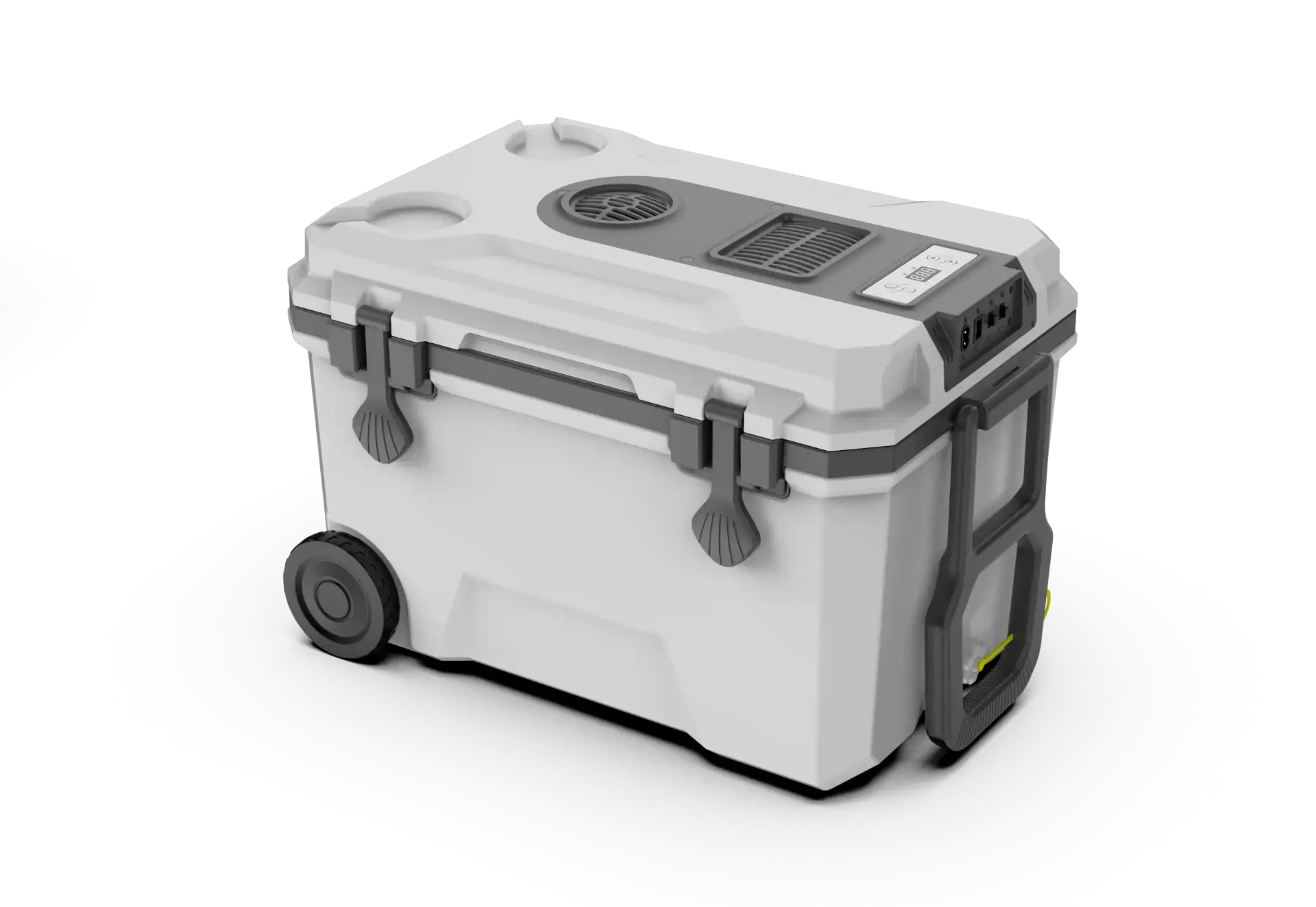
Spec Decisions That Impact Retail Price
A $12 compressor swap can shift your warranty claim rate from 0.3% to 1.2% in hot climates.
When you’re building a private label car fridge, two spec decisions dominate the retail price more than any other: which compressor goes inside and how many temperature zones you offer. Get these right, and your landed cost drops by $15–20 per unit. Get them wrong, and you’re either eating warranty returns or pricing yourself out of the mid-range market.
Compressor Brand: Hua Jun vs Secop Cost Trade-offs
The compressor accounts for roughly 30% of the total BOM cost in a 35L dual-zone car fridge. That’s the single largest component cost, so every buyer looks at it first. The two dominant options for portable DC fridges are Secop (formerly Danfoss) — the European standard — and Hua Jun, a Chinese brand that has become the default for mid-tier production.
Secop compressors run about $28–32 per unit at factory pricing for a BD series model. Hua Jun equivalents land at $14–18. That’s a $12–15 savings per fridge before any other line item is adjusted. On a first order of 500 units, that’s $6,000–7,500 straight to your margin or your retail price reduction.
But here’s where the trade-off shows up in real data. Factories tracking warranty claims over three years report that Secop-equipped fridges have a field failure rate around 0.3% under normal use. Hua Jun units sit closer to 1.2% — but almost entirely in ambient temperatures above 40°C (104°F). If your target market is Australia, the US Southwest, or Middle Eastern countries where cars sit in direct sun, that failure rate gap matters. For temperate markets like Northern Europe or Canada, the difference narrows significantly.
Certification Strategy CE + UKCA + RoHS Only< br > Timeline –4–6 weeks< br > Cost –$200O–300O Add ETL for North America< br > Timeline –+6–8 weeks< br > Cost –+$350O–500O per model $350O–500O added cost deferred until sales justify Dual – Zone Temperature Range Standard ( -20°C to +20°C )< br /> App Integration :Basic temp control< br /> Component Cost :Lower Extended ( -30°C to +25°C ) with App Control< br /> App Integration :Full IoT monitoring< br /> Component Cost :Higher by $8–10 / unit $8–10 per unit premium for wider range and smart features Battery Capacity ( for portable models ) No Battery ( DC – only )< br /> Use Case :Car – only operation< br /> Unit Weight Lighter by ~ .5kg Built – in Li – Ion Battery ( eg ,200Wh )< br /> Use Case :Off – grid camping use< br /> Unit Weight Heavier by ~ .5kg Volume Ramp and After-Sales Support
A factory-backed spare parts agreement cuts return costs by 40% on average.
The first production run of 500 units is where theory meets reality. Your sample approval process might have been flawless, but mass production introduces variables that samples don’t catch — a batch of compressors with slightly different tolerances, a shift worker who missed a torque setting on the PCB bracket, or a foam seal that was compressed during container loading.First Order 500 Units: Defect Rate and Warranty ProcessExpect a defect rate between 0.5% and 1.5% on the first order of a private label car fridge. That’s not a sign of poor manufacturing — it’s the baseline for any new production line before process adjustments tighten the spread. The real question is how your supplier handles those units when they come back.Most factories will ask you to ship defective units back for root cause analysis. That takes weeks and costs you freight both ways. A better approach is the one used by KelyLands’ partner fridge factory in Ningbo: they maintain a dedicated warranty team that logs each failure by serial number, photographs the fault, and issues a replacement unit within 7 working days of receiving the report.The warranty process should be written into your supply agreement before the first PO is placed. Specify the response time (under 48 hours for initial diagnosis), who pays return shipping (factory covers if defect rate exceeds an agreed threshold), and what documentation you need to file a claim (serial number, failure photo, purchase date). Without this framework, every defective unit becomes a negotiation.How Factory-Backed Spare Parts Reduce Return CostsThis is where experienced private label buyers separate themselves from amateurs. Instead of returning an entire faulty fridge — which costs $25–40 in shipping plus restocking fees — you keep a stock of high-failure components at your warehouse and swap them locally.On car fridges, the three components most likely to fail are the compressor control board ($4–6 wholesale), the DC fan motor ($2–3), and the temperature sensor harness ($1–2). If your supplier pre-ships these parts at a ratio of one spare kit per every 20 units sold, your cost to resolve an in-warranty failure drops from $45 (return + replace) to about $8 (local technician swap + part cost).”Competitive pricing and reliable delivery” is what KelyLands secured through its partnership with Mr. Zhou’s Ningbo fridge factory — but reliable delivery means nothing if you’re shipping replacement units across oceans every time a control board fails. A spare parts buffer turns a two-month warranty cycle into a same-day fix.ConclusionThe difference between a profitable private label launch and a costly misstep often comes down to decisions made before the first mold is cut. Choosing between a Hua Jun and Secop compressor, or deciding when to invest in ETL certification, directly shapes your unit cost, warranty exposure, and retail pricing power.
- Hua Jun compressors cut unit cost by $12–15 but raise warranty claims from 0.3% to 1.2% in hot climates.
- ETL certification adds $3,500–5,000 per model and delays launch by up to eight weeks.
- Adopting an existing housing design cuts time-to-shelf from six months to ten weeks.
If you are evaluating a dual zone car fridge OEM supplier for your first run, start by requesting their existing base model spec sheet and defect rate data across the last two production quarters. That single document will tell you more about their quality tolerance than three rounds of sample approval ever could. Review current product specifications on the KelyLands car fridge page to see how factory-backed spare parts programs reduce long-term return costs for brand builders.Frequently Asked Questions
| Spec Decision | Option A | Option B | Retail Price Impact |
|---|---|---|---|
| Compressor Brand | Hua Jun Cost –$12–15/unit Warranty Claim Rate –1.2% in hot climates | Secop Cost –Premium Warranty Claim Rate –0.3% in hot climates | $12–15 per unit savings vs. higher return risk |
| Mold Investment | Existing Housing Design Lead Time –10 weeks Tooling Cost –$O (shared) | Full Custom Injection Molding Lead Time –26 weeks Tooling Cost –$15000–30000 | Faster launch, lower upfront cost vs. unique branding |
What certifications do private label car fridges need?
CE, UKCA, ETL, and RoHS are the standard certifications for private label car fridges. The specific certs required depend on your target market; for example, ETL is typically needed for North America while CE covers. Confirm target market certs before production begins.
What is the typical MOQ for a private label car fridge?
MOQ usually starts around 500 units for a base model with basic branding. Custom injection molding or dual-zone features will push that number higher due to tooling costs. Request MOQ after finalizing spec and customization level.
How long does it take to launch a private label car fridge?
A full launch from base model selection to ETL-certified stock takes about 36 weeks. That timeline shortens if you choose an existing base model instead of full custom injection molding. Plan at least nine months for a first production run.
Which compressor brand should I choose for my car fridge?
Hua Jun compressors offer lower cost while Secop provides better reliability in hot climates. Swapping from Secop to Hua Jun can shift your warranty claim rate from 0.3% to 1.2% in high-temperature. Match compressor choice to your target climate and warranty budget.

 English
  Español
  Français
  Deutsch
  Português do Brasil
  Русский
  한국어
한국어  日本語
日本語  العربية