Vacuum Cleaner Certifications for Global Market Access
Learn key vacuum cleaner certifications like CE, UL, RoHS, and energy labels required for safety and market compliance worldwide.
Reading Time:6 min
|
Word Count:1475
Certifications such as CE, UL, RoHS, and Energy Labels are the cornerstone for vacuum cleaner market access worldwide. This article will comprehensively explain the essential certifications required for vacuum cleaners to comply with global safety, environmental, and performance standards, focusing on the European, North American, and Asian markets. CE marking is mandatory for vacuum cleaners sold in the European Union, covering safety, electromagnetic compatibility, and environmental regulations. UL certification under standard UL 1017 ensures electrical safety compliance of vacuum cleaners in North America.
Vacuum cleaners must secure multiple certifications—CE, UL, RoHS, and Energy Labels—to enter and compete in the global market, assuring safety, environmental compliance, and energy efficiency.
Overview of various certifications for vacuum cleaners, including CE, CSA, UL, and Energy Star.
CE Marking for Vacuum Cleaners
CE marking is mandatory for vacuum cleaners sold in the European Union. It signifies compliance with critical EU directives for safety and electromagnetic compatibility. This process involves a Declaration of Conformity and adherence to the harmonized standard EN/IEC 60335-2-2. Products bearing the CE mark can circulate freely within the EU and associated Economic Area countries.
For vacuum cleaners, CE marking is intrinsically linked to other regulations. Compliance with the RoHS directive, which restricts hazardous substances, is a mandatory part of the overall conformity assessment. This integrated approach ensures products meet comprehensive health and environmental protection standards.
UL Certification and Its Importance
UL certification follows the specific UL 1017 standard for vacuum cleaners in North America. While technically voluntary, it is a practical necessity for market entry and consumer acceptance. The certification process rigorously tests for electrical safety, fire resistance, and performance under both normal and fault conditions.
Manufacturers must submit detailed documentation, including wiring diagrams and bills of materials. Achieving a UL listing requires continuous surveillance, including factory audits and product follow-up services. This ongoing commitment to safety is a powerful trust signal for distributors and end-users alike.
RoHS Compliance: Environmental Responsibility
The RoHS directive restricts hazardous substances like lead, mercury, and cadmium in vacuum cleaners. Products must maintain these restricted substances below defined thresholds, such as 0.1% for lead. This compliance is mandatory within the EU and many other international markets, making it a global baseline.
Verifying RoHS compliance involves obtaining supplier declarations and conducting material testing. Comprehensive documentation is essential to demonstrate adherence. Non-compliance risks market exclusion, significant fines, and reputational damage, aligning enforcement with broader sustainability goals.
Energy Labels: Promoting Efficiency
Energy Labels are mandatory for vacuum cleaners marketed in the EU. They provide consumers with standardized information on energy consumption and efficiency ratings. This transparency guides purchasing decisions towards more environmentally friendly and cost-saving products.
The label designs must comply with specific regulations regarding size and information placement. These labels work alongside CE marking and RoHS compliance to foster a more sustainable product lifecycle from manufacturing to disposal.
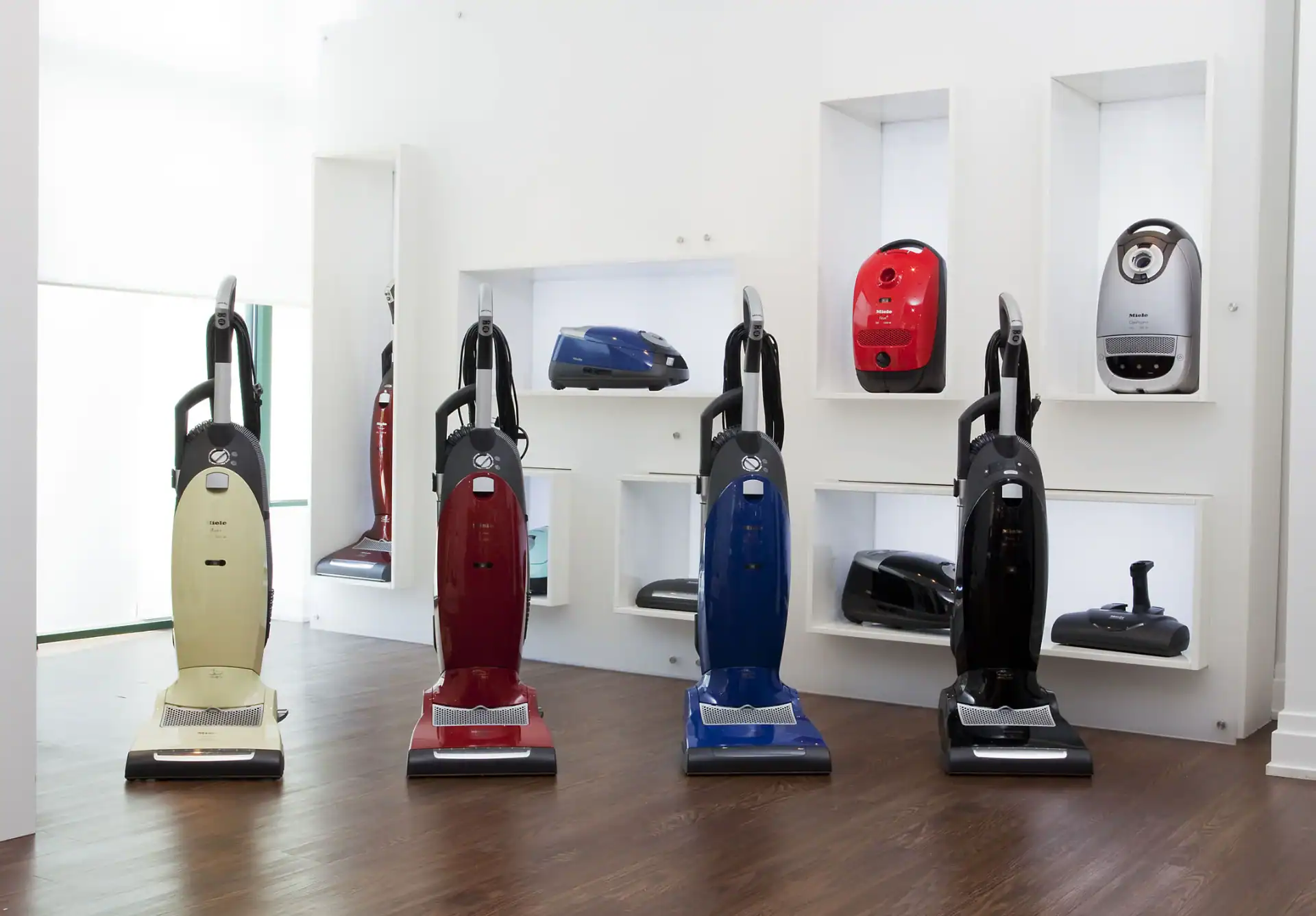
A variety of upright vacuum cleaners displayed in a showroom setting.
Global Certification Landscape and Manufacturer Strategies
Vacuum cleaner certification standards vary significantly by region. The IEC/EN 60335 series, especially part 2-2, provides a harmonized foundation for testing requirements worldwide. The CB Scheme offers an international framework for the mutual recognition of product testing, which can drastically reduce redundant evaluations.
A key distinction lies in the level of assessment. Factory audits and ongoing quality surveillance often differentiate between simple component-level approval and comprehensive whole-unit certification. This difference impacts the perceived reliability and marketability of the final product.
Certification Standards and Marks by Region
Region
Certification Mark
Relevant Standards
Scope and Notes
European Union
CE Mark
EN 60335-2-2, LVD, EMC, RoHS
Mandatory for market access; covers safety, emissions, hazardous substances
United States & Canada
UL / cUL
UL 1017, CSA C22.2 No.243
Widely accepted; includes factory audits; voluntary but practically required
International
CB Scheme
IEC 60335-2-2 and national variants
Mutual recognition reduces repeat testing for multiple markets
Japan
PSE
JIS, DENAN Law
Mandatory electrical appliance safety marking
South Korea
KC
Korean national standards
Mandatory safety and EMC mark
Strategic Certification Advantages for Manufacturers
Comprehensive certifications build immense retailer and consumer confidence. They demonstrate a commitment to reliability and regulatory compliance, reducing barriers to entry. Certifications like CE, UL, and RoHS directly mitigate regulatory risks and can facilitate faster time-to-market.
Energy labeling offers a clear point of competitive differentiation through verifiable sustainability claims. Maintaining factory certification with ongoing audits assures consistent quality in large-scale production. Aligning product design early with these multifaceted requirements avoids costly redesigns and project delays later.
Keep your vehicle spotless with KelyLands’ lightweight vacuums featuring strong suction, versatile tools, quiet operation, and cordless charging. Customize your order with OEM options and enjoy trusted quality backed by global certifications and support.
Certification Implications for Different Customer Segments
Tailored certification communication strategies enable manufacturers to meet the specific needs and risk profiles of diverse customers.
European Wholesalers and Retail Distributors
This segment prioritizes CE, RoHS, and UKCA certifications to meet strict regulatory demands. They seek partners with robust factory audits as a key risk mitigation measure. Highlighting quality assurance processes, including triple testing, is crucial for securing large contracts.
Demonstrating stable production capacity is essential for handling large seasonal orders. Offering product customization capabilities provides a valuable point of differentiation in a highly competitive marketplace.
North American E-commerce Brands
These buyers stress UL certification and FCC compliance for safe market access. They value low MOQ policies to reduce inventory risk when testing new product SKUs. Providing certified performance data on suction power and noise levels supports their marketing efforts.
Ready-made marketing assets backed by certified compliance are highly valued. Suggestions for packaging and logistics optimization can seal the deal by reducing their overall fulfillment costs.
Appliance and Lifestyle Brands
Premium brands showcase design innovation backed by stringent certifications. They require ironclad IP protection and NDA adherence for their proprietary designs. Customization in materials and finishes, supported by certified environmental claims, is a standard expectation.
They underline user experience improvements enabled by robust safety and energy standards. Sustainability credentials like RoHS and energy efficiency resonate deeply with their target consumer base.
Large Retail Chains and Supermarket Buyers
These buyers demand transparent certification and quality documentation for their procurement processes. They quantify large-scale production capabilities and steady supply capacity above all else. Emphasizing the total cost of ownership benefits from high-quality certified products is key.
They require packaging and logistics support for streamlined inventory management. A commitment to compliance risk reduction through surveillance systems ensures a reliable long-term partnership.
Documents and stopwatch illustrating the CE certification process for a vacuum cleaner.
Frequently Asked Questions
What certifications are mandatory for vacuum cleaners in the EU and US?
In the European Union, CE marking, RoHS compliance, and an Energy Label are mandatory for vacuum cleaners. For the US market, UL certification (under standard UL 1017) is not legally mandatory but is effectively required by retailers and distributors for liability protection. FCC compliance for electromagnetic interference is also a legal requirement in the US.
How does the CB Scheme facilitate international certification?
The CB Scheme is an international framework based on IEC standards. It allows for mutual acceptance of test reports across over 50 participating countries. This means a vacuum cleaner tested once to IEC 60335-2-2 can have that report recognized by certification bodies in other member nations, significantly reducing the cost and time of redundant testing.
The risks are severe and include being denied market access in the EU and other regions that adopt similar rules. Companies face the potential for hefty fines, product recalls, and significant reputational damage. Non-compliance signals a failure in environmental responsibility and supply chain management.
Are UL marks mandatory for vacuum cleaners to enter the North American market?
UL marks are not a government mandate but are a critical market requirement. Major retailers, online marketplaces, and insurance companies almost universally require UL certification. It serves as their primary proof of due diligence regarding product safety, making it a de facto necessity for commercial success.
How can manufacturers leverage Energy Labels in marketing vacuum cleaners?
Energy Labels provide a standardized, government-backed measure of efficiency. Manufacturers can prominently feature a high efficiency rating (A+++) in marketing materials to appeal to cost-conscious and environmentally aware consumers. This transparent data helps differentiate products in a crowded market based on tangible performance and sustainability benefits.
Hi, I’m Hanke Chen, the Head of KelyLands Sales Team. With over a decade of experience as a sales engineer, I bring in-depth expertise in the design, production, and sales of car accessories.
Please leave your information here, our team will get back to you soon..
WhatsApp us
We use cookies to ensure that we give you the best experience on our website. If you continue to use this site we will assume that you are happy with it.
 跳转到主要内容 跳转到页脚





 English
  Español
  Français
  Deutsch
  Português do Brasil
  Русский
  한국어
한국어  日本語
日本語  العربية